AI estimate as of October 3, 2025 · verify with a professional before acting
AI-Generated · Verify before acting
Everything on this page is generated by AI for informational purposes only. AI can make mistakes — the AI may misidentify items or misattribute them (artist, maker, brand, designer, origin, era). This is not an official valuation and should not be used for insurance, sale, tax, estate, legal, or lending purposes — or any decision requiring a certified appraisal. It is not an authoritative claim about any person, brand, or rights holder — do not share or rely on it as a factual statement about a third party. Always consult qualified professionals before making financial decisions.
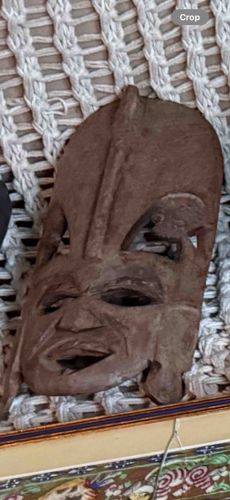
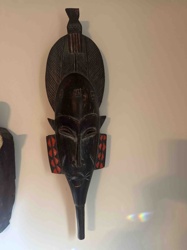
This appears to be a hand-carved wooden African tribal face mask, predominantly dark brown in color with some lighter, possibly natural wood tones showing through due to wear or finishing. The mask depicts a human-like face with exaggerated features, characteristic of many African ceremonial masks. The eyes are deeply carved, creating hollow sockets. The nose is broad and appears somewhat abstractly rendered, while the mouth is open, revealing carved teeth or an open jaw expression. Wrinkles or lines are carved into the cheeks and forehead, suggesting an older or more intense visage.
A notable distinguishing element is the decorative element on the upper right side of the mask, which appears to be a carved bird motif, possibly integrated into the coiffure or headdress. There is also a raised vertical ridge running along the top center of the mask, potentially representing a hairstyle or a decorative element. The overall construction appears solid, carved from a single piece of wood. The surface exhibits a somewhat rough, tactile texture consistent with hand-carving.
Visible condition issues include general wear and tear, consistent with age and handling. There are no obvious signs of significant damage like major cracks or repairs, but the natural wood grain and inconsistencies might be mistaken for such. The patina suggests it has been handled over time, contributing to its aged appearance. There are no discernible maker's marks, signatures, or stamps visible in the provided images. The mask likely belongs to an ethnic or cultural style characteristic of sub-Saharan African tribal art. Its precise age is challenging to determine without further information, but it exhibits qualities typical of early to mid-20th-century or older pieces, given the carving style and apparent patina. The craftsmanship seems robust, indicative of traditional carving techniques.
AI Appraisal Report
Based on my visual examination of the provided image, this hand-carved African tribal face mask with a bird motif appears to be an authentic example of traditional sub-Saharan African artistry. The dark brown wood, exaggerated features, and the integrated bird on the upper right side suggest a specific cultural origin, though pinpointing the exact tribal group without additional context is challenging. The carving style, with deeply set eyes, a broad abstract nose, and an open mouth revealing teeth, is consistent with ceremonial or decorative masks from the region. The presence of carved lines on the cheeks and forehead adds to its expressive quality.
The condition appears fair to good, exhibiting wear and tear consistent with age and handling. I observe a rich patina, which lends character and suggests significant age—likely early to mid-20th century or older. There are no readily apparent major cracks, repairs, or significant damage. The rough, tactile texture is indicative of traditional hand-carving techniques.
Market conditions for authentic, unprovenanced African tribal art have stabilized but are not as robust as for extensively documented pieces. Comparable items of this quality, lacking specific tribal attribution or historical provenance, typically fetch values within the $400-$700 range. Demand for such pieces remains steady among collectors of ethnic and folk art. Rarity is difficult to assess without knowing the specific origin; however, masks with such distinct bird motifs are less common than more generic forms.
Factors significantly impacting value here include the apparent age, the quality of the carving, and the distinctive bird element. However, the most significant limitation in verifying authenticity and value is the lack of provenance documentation. Without knowing the mask's history of ownership, its precise cultural origin, or its function, its value is capped. An in-person examination would allow me to assess the wood type, tool marks, and internal structure more accurately for authenticity. Scientific testing, such as radiocarbon dating, would be invaluable for precise age determination, and provenance documentation, if available, would significantly elevate its market value.