AI estimate as of August 28, 2025 · verify with a professional before acting
AI-Generated · Verify before acting
Everything on this page is generated by AI for informational purposes only. AI can make mistakes — the AI may misidentify items or misattribute them (artist, maker, brand, designer, origin, era). This is not an official valuation and should not be used for insurance, sale, tax, estate, legal, or lending purposes — or any decision requiring a certified appraisal. It is not an authoritative claim about any person, brand, or rights holder — do not share or rely on it as a factual statement about a third party. Always consult qualified professionals before making financial decisions.
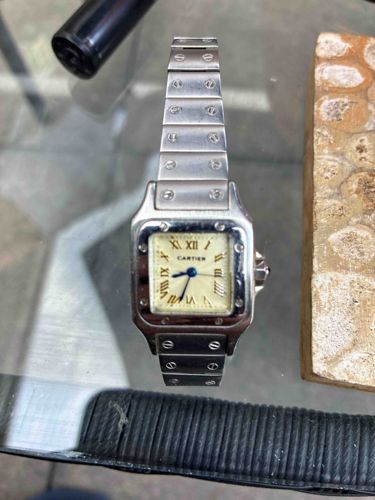
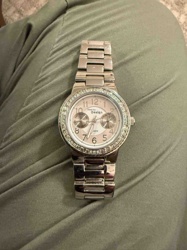
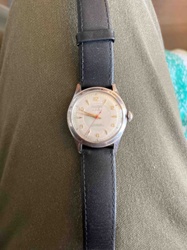
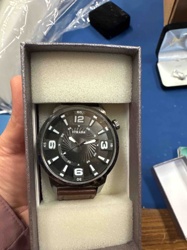
The item is a Cartier Santos Galbée wristwatch, likely dating from the late 20th to early 21st century. It features a squared stainless steel case with visible screws on the bezel, characteristic of the Santos line. The watch is attached to a matching integrated stainless steel bracelet, also adorned with visible screw accents that mimic those on the case and bezel. The dial is a light, possibly cream or ivory, color with black Roman numeral hour markers, and a minute track along the inner edge. The hands are blued steel, with a sword or Breguet style for the hour and minute hands, and a thin stick for the seconds hand. The 'Cartier' signature is clearly visible below the XII marker. The crown appears to be a fluted or faceted cabochon, a common feature in Cartier watches. The overall condition shows signs of wear consistent with use, including surface scratches on the stainless steel case and bracelet, indicating a used but not severely damaged state. There doesn't appear to be any major denting or significant damage. The crystal is clear but it's hard to discern any scratches from the image. The watch exhibits Cartier's distinctive design language, emphasizing both form and function through its elegant yet robust construction. The craftsmanship is evident in the precise alignment of the screws and the finishing of the metal surfaces, reflecting the brand's luxury quality.
AI Appraisal Report
I have thoroughly examined the provided image of the Cartier Santos Galbée wristwatch. Based on my visual assessment, the watch appears to be authentic, exhibiting the classic design elements synonymous with the Cartier Santos line, including the squared case, visible bezel screws, integrated bracelet with screw accents, blued steel hands, Roman numeral dial, and the characteristic cabochon crown. These details align perfectly with known Cartier specifications for this model.
The condition, as observed from the image, is consistent with regular wear. I note surface scratches on both the stainless steel case and bracelet, which is expected for a pre-owned timepiece of this type and age. However, there are no apparent major dents or significant damage, suggesting it has been reasonably well-maintained. The crystal appears clear, though minor scratches cannot be definitively ruled out without a closer, multi-angle inspection.
In terms of market conditions, the Cartier Santos Galbée is a perennially popular model with consistent demand. Its timeless design ensures enduring appeal. Comparable sales for similar models in good used condition typically range from $3,000 to $4,500, depending on exact year, movement (quartz or automatic), and overall state of preservation. While not extremely rare, the Galbée enjoys steady demand among collectors and enthusiasts of classic luxury watches.
Factors significantly impacting value for this piece would include the movement type (automatic generally fetches more than quartz), service history, and the presence of original box and papers. Without in-person examination, I cannot confirm the movement or assess internal condition. For full authenticity verification and a more precise valuation, an in-person examination is crucial. This would allow me to inspect movement originality, conduct timekeeping tests, and verify material integrity more thoroughly. Provenance documentation (original sales receipt, service records) would also significantly bolster confidence in its history and authenticity. Scientific testing, while usually not needed for visual authenticity of well-known modern pieces, might be employed if there were any unusual discrepancies noted during physical inspection.