These notes were written by the person who submitted this item. Appraiser.AI has not verified them, and the AI's identification and estimate may rely on them.
AI Estimated Value
Not an official valuation
$3,500 - $5,00_0
AI estimate as of September 1, 2025 · verify with a professional before acting
AI-Generated · Verify before acting
Everything on this page is generated by AI for informational purposes only. AI can make mistakes — the AI may misidentify items or misattribute them (artist, maker, brand, designer, origin, era). This is not an official valuation and should not be used for insurance, sale, tax, estate, legal, or lending purposes — or any decision requiring a certified appraisal. It is not an authoritative claim about any person, brand, or rights holder — do not share or rely on it as a factual statement about a third party. Always consult qualified professionals before making financial decisions.
This analysis also relies on unverified notes provided by the user, which may be incomplete or inaccurate and could affect the result.
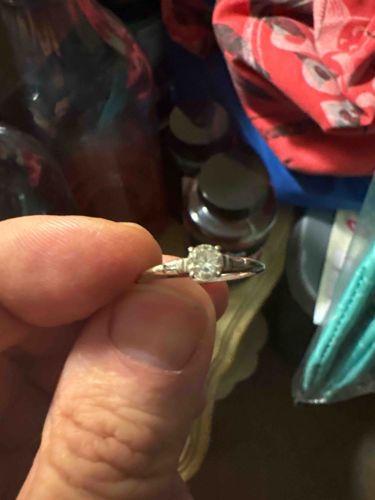
The item is a ring, featuring a central round brilliant cut diamond flanked by two baguette cut diamonds on a white metal band, likely platinum or white gold. The central diamond appears to be held in a classic four-prong setting, ensuring maximum light exposure and brilliance. The two side diamonds are horizontally set into the band, creating a tapered or stepped effect that draws attention to the center stone. The band itself is relatively thin and polished, showing some signs of light wear typical of a frequently worn piece of jewelry, such as minor scratches or surface abrasions. The overall design suggests a traditional engagement ring style, possibly dating from the mid-20th century, given the popular use of baguette side stones during that period. The craftsmanship appears to be of good quality, with precise stone settings and a smooth finish on the metal. There are no visible major cracks, chips, or significant damage to the stones or the metal, though a professional cleaning and polishing might enhance its appearance. No specific maker's marks or engravings are discernible from the provided image.
AI Appraisal Report
I have carefully examined the provided image of the diamond ring. The item is a classic three-stone ring, featuring a central round brilliant cut diamond flanked by two baguette cut diamonds, set in what appears to be a white metal band, likely platinum or white gold. The setting style for the central diamond (four-prong) is classic and efficient for maximizing light. The baguette side stones are horizontally set, a popular design feature that creates an elegant tapered look. The overall condition appears good, with minor surface wear on the band, consistent with a frequently worn piece. I see no obvious chips or major damage to the stones or metal from the image provided. This design suggests a mid-20th century origin, a period known for this style of setting.
Market conditions for classic diamond rings remain stable, driven by consistent consumer demand for engagement and anniversary jewelry. Comparables for such pieces depend heavily on the 4Cs (Carat, Color, Clarity, Cut) of the central diamond, which cannot be definitively assessed from an image. The presence of baguette side stones adds to the value and desirability. The rarity of this specific piece is moderate; while the design is common, the quality of the diamonds would dictate its unique value.
Factors significantly impacting value include the precise carat weight, color, and clarity of the central diamond, as well as the quality of the baguette diamonds and the purity of the metal. Without knowing these specifics, the valuation is an estimate.
It is crucial to state the limitations of this appraisal. Authenticity verification and precise valuation from images alone are inherently limited. To provide a definitive appraisal, I would require an in-person examination to assess the 4Cs of the diamonds using professional gemological tools, test the metal purity, and check for any internal inclusions or treatments. Certification from a reputable gemological lab (e.g., GIA, AGS) for the center diamond would significantly enhance its market value and my ability to appraise it accurately. Provenance documentation, if available, could also add to its historical or sentimental value.