AI estimate as of August 10, 2025 · verify with a professional before acting
AI-Generated · Verify before acting
Everything on this page is generated by AI for informational purposes only. AI can make mistakes — the AI may misidentify items or misattribute them (artist, maker, brand, designer, origin, era). This is not an official valuation and should not be used for insurance, sale, tax, estate, legal, or lending purposes — or any decision requiring a certified appraisal. It is not an authoritative claim about any person, brand, or rights holder — do not share or rely on it as a factual statement about a third party. Always consult qualified professionals before making financial decisions.
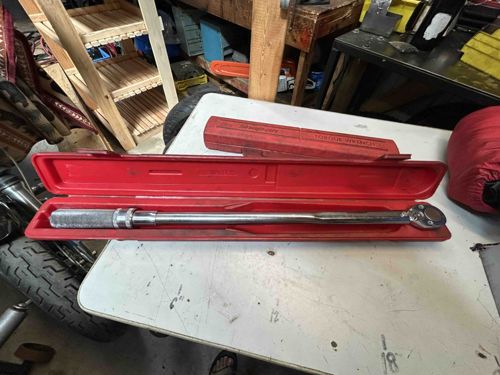
The item is a click-type torque wrench, presented within its original red plastic storage case. The torque wrench itself is predominantly constructed from a metallic material, likely chromed steel, giving it a bright, reflective, and durable appearance. It features a long, slender shaft, indicating it's designed for applications requiring significant leverage and precise torque settings. One end of the wrench has a textured, knurled handle, presumably for a secure grip during use. This handle section appears to be a darker grey, possibly due to a different finish or wear on the knurling. The working end of the wrench features a square drive, which is characteristic of most torque wrenches for attaching sockets. The visible drive size appears to be 1/2 inch, a common size for automotive and heavy-duty applications. The overall finish of the metal is glossy, showing some reflections, but also some minor scuffs or smudges consistent with use. There are no obvious signs of significant corrosion, bending, or severe damage. The red plastic case is hinged and molded to securely hold the wrench. The exterior of the case, which is visible in the background, has raised lettering, indicating "TORQUE WRENCH" and perhaps other instructional or branding information, though the specific text is not fully legible. The condition of the case appears to be good, with no major cracks or breaks observed. The wrench appears to be a standard, good-quality tool, likely manufactured for the automotive or mechanical trade. Based on its design and the presence of a dedicated case, it suggests a tool intended for precision and longevity. No specific maker's marks are clearly discernible from the image, nor is a precise age, but the style is consistent with wrenches produced in the latter half of the 20th century to the present day.
AI Appraisal Report
Upon visual examination of the provided image, I assess this click-type torque wrench to be in good, used condition. The metallic components, likely chromed steel, exhibit a bright, reflective finish with only minor scuffs or smudges consistent with typical use. No overt signs of significant corrosion, bending, or severe damage are apparent. The knurled handle shows some wear, understandable for an actively used tool. The red plastic case is intact and appears functional, providing adequate protection for the wrench. Authenticity, based solely on visual cues, suggests a standard, commercially manufactured torque wrench. There are no elements that raise immediate red flags regarding its genuineness as a functional tool.
In terms of market conditions, standard click-type torque wrenches with a 1/2-inch drive are readily available new, ranging from budget-friendly options to professional-grade tools. Used examples often fetch a significant discount. Demand for such tools is consistent within automotive and mechanical trades, but supply is high, mitigating rarity. The lack of discernible maker's marks from the image prevents an assessment of a specific brand's reputation, which significantly impacts value. Factors affecting this item's value include its good physical condition and the presence of its original case, which adds to its completeness and protection. However, without knowing the specific manufacturer, calibration status, or service history, its value is primarily as a generic, used tool.
Limitations in authenticity verification are significant based purely on images. A physical examination would allow me to check for internal wear, verify accuracy with a torque tester, assess the functionality of the click mechanism, and inspect for subtle manufacturing defects or repair history. I would also seek any serial numbers or manufacturer's stamps that might be obscured in the image. Provenance documentation (e.g., purchase receipts, calibration certificates) and direct physical inspection are essential for a definitive assessment of authenticity, precise age, and overall operational integrity, which are critical for professional tools.