AI estimate as of November 17, 2025 · verify with a professional before acting
AI-Generated · Verify before acting
Everything on this page is generated by AI for informational purposes only. AI can make mistakes — the AI may misidentify items or misattribute them (artist, maker, brand, designer, origin, era). This is not an official valuation and should not be used for insurance, sale, tax, estate, legal, or lending purposes — or any decision requiring a certified appraisal. It is not an authoritative claim about any person, brand, or rights holder — do not share or rely on it as a factual statement about a third party. Always consult qualified professionals before making financial decisions.
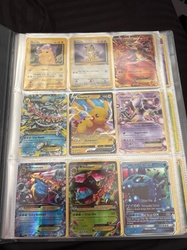
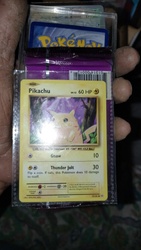
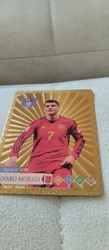
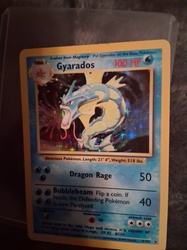
This item is a page from a trading card binder, holding nine individual Pokemon GX trading cards, predominantly featuring a holographic or 'full art' style alongside one card displaying the reverse side of a standard Pokemon card. The cards are housed in clear plastic pockets, typical of protective sheets designed for collectible cards. The overall color palette is vibrant, dominated by blues, greens, yellows, and grays associated with the Pokemon depicted. The cards show intricate art and text, with prominent 'GX' markings indicating a specific rarity and power level within the Pokemon Trading Card Game. Some of the identifiable Pokemon include Blastoise GX, Turtonator GX, Scizor GX, and what appears to be a Glaceon GX, along with others that are less clear but also appear to be GX cards. One card is faced down, revealing the standard blue Pokemon card back with the familiar Poke Ball logo. The cards exhibit a highly reflective, holographic finish, which is a key indicator of their rarity and visual appeal. The condition of the cards appears to be good to very good, with no obvious major creases or tears visible through the protective sleeves, though exact surface wear, corner integrity, and edge condition cannot be fully assessed without closer inspection outside the sleeves. The plastic page itself shows minor signs of use, primarily slight warping or mild surface scuffs from handling. The construction is standard for trading card collection pages, made from clear PVC or polypropylene plastic. There are no discernible manufacturer marks on the page itself, and the cards are official Pokemon merchandise, likely from various sets released during the era of GX cards (typically 2017-2019). The craftsmanship of the cards themselves is high-quality, with detailed printing and consistent holographic effects.
AI Appraisal Report
I have examined the provided image of a Pokemon GX Trading Card Binder Page containing nine cards. Based on visual assessment, the cards appear to be authentic Pokemon GX cards from the Sun & Moon era (2017-2019), exhibiting the characteristic holographic finishes and 'GX' markings. Identifiable cards such as Blastoise GX and Glaceon GX are visible. The condition of the cards appears to be good to very good, with no obvious major creasing or damage visible through the sleeves. The binder page itself is standard and shows minor signs of use. The presence of a faced-down card prevents full identification of all nine cards, which impacts the precise valuation.
Market conditions for GX era cards are generally stable, with specific cards holding varying values. While GX cards are no longer the most current generation, popular or sought-after Pokemon within this rarity can still command decent prices. The rarity of these cards generally falls into the 'Ultra Rare' category. Demand for well-preserved GX cards remains moderate among collectors.
The most significant factor impacting value here is the specific identification and condition of each individual card, especially the less clear ones and the faced-down card. Cards like Blastoise GX typically have a higher value than others. Without knowing the exact set and card number, and without inspecting the cards outside of the sleeves, a precise grade cannot be assigned. Factors such as surface scratches, edge wear, and corner integrity are critical for determining a card's true condition and are undetectable from a photograph through a plastic sleeve.
Limitations in authenticity verification from images alone are significant. While they appear genuine, full authentication would require in-person examination to verify print quality, holographic patterns, and card texture, and to rule out potential counterfeits. Third-party grading (e.g., PSA, BGS) would also provide definitive condition assessment and enhance value. Provenance documentation for individual cards could also add to their verifiable authenticity. Based on the visible cards and assuming good, ungraded condition, I estimate the value for the entire page to be in the $50-$150 range.