AI estimate as of November 20, 2025 · verify with a professional before acting
AI-Generated · Verify before acting
Everything on this page is generated by AI for informational purposes only. AI can make mistakes — the AI may misidentify items or misattribute them (artist, maker, brand, designer, origin, era). This is not an official valuation and should not be used for insurance, sale, tax, estate, legal, or lending purposes — or any decision requiring a certified appraisal. It is not an authoritative claim about any person, brand, or rights holder — do not share or rely on it as a factual statement about a third party. Always consult qualified professionals before making financial decisions.
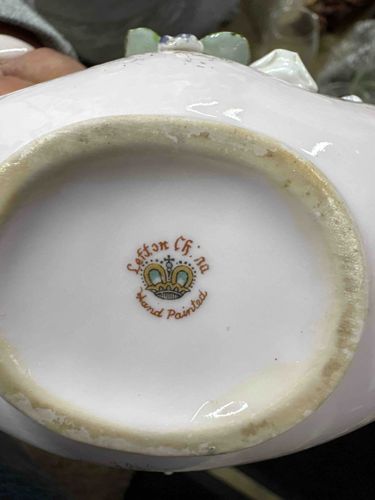
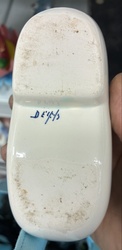
This item is an oval-shaped ceramic vessel, likely a planter or a trinket dish, crafted from fine white porcelain with a glossy glaze. The overall form suggests it is part of a decorative array, possibly designed for floral arrangements or as a standalone ornamental piece. The image primarily focuses on the base, revealing a distinct manufacturer's mark. The base is an unglazed oval foot-rim, displaying a natural bisque color with some age-related discoloration and minor surface adherence, possibly from display or use. The interior of the base, within the foot-rim, is glazed white and features a vibrant, hand-painted mark. This mark includes the text "Lefton Ch.na" in stylized red script above a gold and blue crown motif, with the words "Hand Painted" in matching red script curved beneath the crown. The crown itself is detailed with green and blue accents, indicating a multi-color application. The presence of 'Hand Painted' signifies individual craftsmanship and attention to detail during production. The visible upper edge of the item shows hints of three-dimensional floral or foliage appliques in light green and white, suggesting a decorative top rim or accent. The condition of the foot-rim indicates some wear and accumulation of residue consistent with an older item, but the glazed interior and manufacturer's mark appear well-preserved. Based on the 'Lefton China' mark, the piece likely dates from the mid-20th century, specifically after George Lefton established his import company in 1940 and began importing ceramics from Japan. The quality of the porcelain and hand-painted details suggests good craftsmanship for its style period, likely an American import from Japan.
AI Appraisal Report
I have carefully examined the provided image of this Lefton China Hand Painted Planter or Trinket Dish. The item appears to be an authentic Lefton piece, indicated by the distinctive "Lefton China Hand Painted" mark featuring the crown motif, consistent with those used by the company after its founding by George Lefton. The presence of 'Hand Painted' signifies individual craftsmanship, characteristic of Lefton's imported ceramics from Japan during the mid-20th century.
The condition, as assessed from the image, shows an unglazed foot-rim with some age-related discoloration and minor surface adherence, suggesting typical wear for an item of its age. However, the glazed interior and the manufacturer's mark are well-preserved and vibrant, which is a positive factor. The visible hints of three-dimensional floral or foliage appliques suggest a decorative top rim, enhancing its aesthetic appeal.
Lefton China items, especially decorative planters and trinket dishes with hand-painted details, are generally common in the secondary market. While there's a steady demand from collectors of vintage decorative ceramics, this particular type of item is not considered rare. Factors impacting value include the piece's specific design, overall condition, and the completeness of any applied ornamentation. Items with significant damage, fading, or missing elements would fetch lower prices.
My appraisal is limited by the visual information available. Without a physical in-hand examination, I cannot definitively ascertain the absence of hairline cracks, chips, or repairs that might not be visible in the image. A full assessment would require examining the piece from all angles, feeling for imperfections, and checking translucency. Provenance documentation, though unlikely for an item of this value, would confirm its history. Scientific testing is not typically applied to items of this nature for authentication purposes. Based on the visual evidence, I assess its fair market value to be in the range of $25-$45.