AI estimate as of August 1, 2025 · verify with a professional before acting
AI-Generated · Verify before acting
Everything on this page is generated by AI for informational purposes only. AI can make mistakes — the AI may misidentify items or misattribute them (artist, maker, brand, designer, origin, era). This is not an official valuation and should not be used for insurance, sale, tax, estate, legal, or lending purposes — or any decision requiring a certified appraisal. It is not an authoritative claim about any person, brand, or rights holder — do not share or rely on it as a factual statement about a third party. Always consult qualified professionals before making financial decisions.
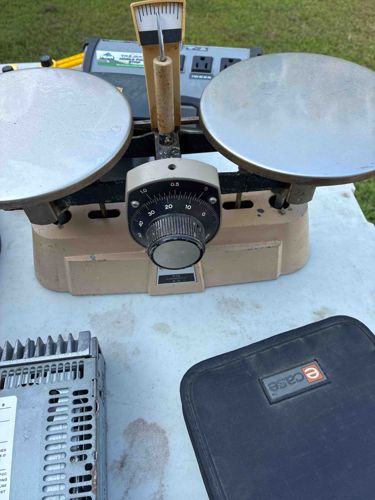
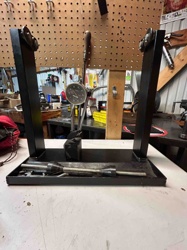
The item is a two-pan analytical balance, likely a triple beam balance or similar laboratory/precision scale. Its primary components include a sturdy, rectangular base structure, a central column supporting the balance mechanism, and two circular weighing pans. The base appears to be constructed from a light-colored, possibly beige or cream-colored, painted metal or heavy-duty plastic, exhibiting some surface wear and minor discoloration consistent with age and use. The balance arm, connecting the two pans, appears to be made of dark-colored metal, possibly painted cast iron or steel, showing some loss of finish or scuffs. The two weighing pans are circular, made of a lighter, metallic material, such as stainless steel or aluminum, with a brushed or matte finish, showing signs of use with minor scratches and smudges. A prominent feature is the central dial and indicator mechanism located below the balance arm. This mechanism includes a large, ridged black knob, likely for fine-tuning the balance or taring, surrounded by a white or light-colored face with numerical markings ranging from what appears to be 0 to 50, with subdivisions, and additional markings for 0.5 and 1.0. Above this dial, a vertical pointer swings along a marked scale to indicate equilibrium or weight difference, which also shows some discoloration. The overall construction suggests a robust and functional design, built for precise weighing. There are no clearly visible manufacturer's marks or model numbers in the provided image. The aged appearance, particularly the wear on the painted surfaces and the patina on the metal components, suggests that the balance is not new and could date from the mid to late 20th century. The craftsmanship appears utilitarian and robust, designed for practicality rather than aesthetic finesse, indicative of a scientific or industrial tool.
AI Appraisal Report
Upon visual examination of the provided image, I assess this two-pan analytical balance to be in fair to good condition, consistent with a mid to late 20th-century scientific instrument. Authenticity, based solely on visual cues, appears genuine as a vintage laboratory balance; there are no obvious signs of it being a replica. The wear on the painted surfaces, scuffs on the metal components, and discoloration on the dial suggest typical aging and use rather than intentional distressing.
In terms of market conditions, vintage laboratory equipment like this balance has a niche but steady demand among collectors, educational institutions, and individuals seeking functional display pieces. Comparable items, particularly triple beam balances or similar precision scales from reputable manufacturers (e.g., Ohaus, Sartorius), typically sell in the range of $75 to $200, depending heavily on condition, completeness, and original manufacturer. The lack of visible manufacturer's marks significantly impacts its value, as branded items command higher prices due to established reputation and quality. Rarity is low; while not mass-produced, these scales were common in laboratories and are not inherently rare.
Factors significantly impacting value include the absence of manufacturer's marks, which prevents definitive identification of its origin and quality, and the general wear and tear. Its aesthetic appeal is purely utilitarian.
Limitations in authenticity verification from images alone are significant. A full in-person examination would be critical to assess the functionality of the balance mechanism, the precision of the tare/indicator dial, and to check for hidden damage, missing parts, or repairs. Provenance documentation (e.g., purchase records, laboratory asset tags) would establish its history and potential reputable origin. Scientific testing, while not typically applied to these items for authentication, could confirm material composition if there were doubts about, for instance, a rare metal component. Without these, my appraisal is based purely on visual condition and generalized market trends for similar unbranded items.