AI estimate as of October 25, 2025 · verify with a professional before acting
AI-Generated · Verify before acting
Everything on this page is generated by AI for informational purposes only. AI can make mistakes — the AI may misidentify items or misattribute them (artist, maker, brand, designer, origin, era). This is not an official valuation and should not be used for insurance, sale, tax, estate, legal, or lending purposes — or any decision requiring a certified appraisal. It is not an authoritative claim about any person, brand, or rights holder — do not share or rely on it as a factual statement about a third party. Always consult qualified professionals before making financial decisions.
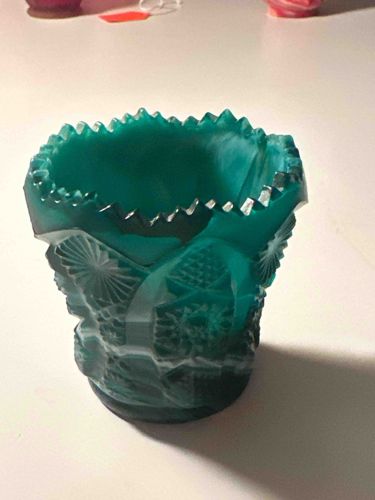
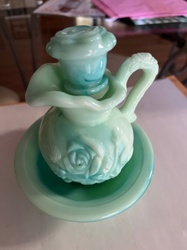
This item is a small, possibly antique or vintage, decorative vase or holder crafted from what appears to be teal/turquoise milk glass. Its most striking feature is the heavily textured exterior, adorned with intricate patterns that suggest a pressed glass manufacturing technique. The patterns include a fan or sunburst motif, as well as a more geometric, possibly diamond-point or hobnail-like design, creating a rich visual and tactile surface. The color is a consistent, opaque teal or turquoise, characteristic of milk glass from certain eras, particularly giving it a somewhat milky or opaque, rather than translucent, appearance. The top rim of the piece is distinctively scalloped or jagged, with pointed protrusions that add to its decorative appeal and unique silhouette. The interior appears smooth by contrast, and the item has a solid, sturdy base. There are no immediately obvious visible condition issues such as chips, cracks, or significant wear, though the lighting makes it difficult to assess fine details. The style suggests it could be from the late 19th or early 20th century, a period known for its elaborate pressed glass designs. Without specific maker's marks, pinpointing exact origin or age is challenging, but the craftsmanship of the intricate pattern points to a well-made, decorative piece, likely intended for holding small flowers, pens, or simply as an ornamental object.
AI Appraisal Report
Based on my visual examination of the provided image, this Teal Milk Glass Scalloped Edge Vase/Holder appears to be in very good condition, with no immediately visible chips, cracks, or significant wear. The opaque teal/turquoise color is consistent, characteristic of art glass or milk glass from the late 19th or early 20th century. The intricate pressed glass patterns, including the fan/sunburst and geometric designs, are well-defined, and the scalloped rim is intact, adding to its decorative appeal.
Authenticity of its age (late 19th/early 20th century) is strongly suggested by its style and manufacturing technique. Such pieces were popular during the Victorian and Edwardian eras. Comparable examples of colored milk glass vases and holders from this period, particularly those with intricate patterns, generally command prices in the range of $50-$150, depending on condition, rarity of the specific pattern, and color. Teal milk glass is less common than white, adding a slight premium. The demand for decorative vintage and antique glass remains steady among collectors of specific glass types and those seeking period decor.
Factors impacting value include the excellent apparent condition and the attractive, less common teal color. However, without maker's marks, it's difficult to attribute to a specific, highly collectible manufacturer, which would significantly increase its value. My primary limitation in this appraisal is the reliance on images alone. An in-person examination would be crucial to confirm the absence of minute chips or hairline cracks, assess the actual texture and weight, and search for any faint maker's marks that might be obscured in the photograph. Chemical analysis of the glass composition could definitively date the piece, but is generally not economically warranted for items in this price range. Overall, I assess its fair market value to be in the range of $60 to $100.