AI estimate as of November 18, 2025 · verify with a professional before acting
AI-Generated · Verify before acting
Everything on this page is generated by AI for informational purposes only. AI can make mistakes — the AI may misidentify items or misattribute them (artist, maker, brand, designer, origin, era). This is not an official valuation and should not be used for insurance, sale, tax, estate, legal, or lending purposes — or any decision requiring a certified appraisal. It is not an authoritative claim about any person, brand, or rights holder — do not share or rely on it as a factual statement about a third party. Always consult qualified professionals before making financial decisions.
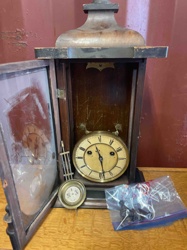
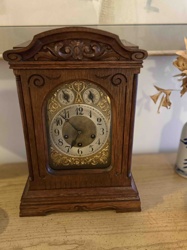
This appears to be an antique mantel clock, likely dating from the late 19th or early 20th century, possibly an American 'shelf clock' or 'parlor clock' given its common form. The clock features a rectangular, architectural case constructed from a dark material, most probably ebonized wood or potentially slate/marble, which has been polished to a glossy black finish. The top of the case has a slightly overhanging, stepped cornice, and the base is a substantial, stepped plinth providing stability. The front facade of the main body, flanking the central clock face, exhibits subtle, etched or gilt decorations in a foliate or scrollwork pattern, indicating a classic or Victorian design aesthetic. These decorations show some wear, suggesting age and handling. The circular clock face is encased in a significant, highly ornate gilt metal bezel with a textured, possibly chased or repoussé, pattern around its circumference. The dial itself is off-white or cream-colored, showing significant age-related discoloration and possibly some staining or patination, contributing to its antique character. It features black Roman numerals for the hours and a minute track, with two black, ornate 'spade' or 'Breguet' style hands for hours and minutes. The glass covering the dial is not fully visible but is presumed to be present. Several scratches and scuffs are visible on the glossy black finish of the base and corners, consistent with typical wear for an item of this age. No manufacturer's marks or signatures are immediately discernible from the provided image. The overall construction appears solid and well-crafted, typical of timepieces from its era, designed for display on a mantelpiece, shelf, or table.
AI Appraisal Report
Based on my visual examination of the provided image, this antique black mantel clock appears to be a late 19th or early 20th-century American parlor or shelf clock. The architectural case, likely ebonized wood or slate/marble, is consistent with styles popular during that period. The gilt dial with Roman numerals and 'spade' hands further supports this dating. The ornate gilt metal bezel is a desirable feature.
In terms of condition, I note significant age-related discoloration and patination on the dial, which is expected for an item of this vintage. There are visible scratches and scuffs on the glossy black finish of the base and corners, indicating typical wear and tear from age and handling. The subtle, etched gilt decorations on the front facade also show wear. While these imperfections affect the 'as-new' appearance, they contribute to its antique character and are generally acceptable for an item of this age. However, significant damage or missing parts, not fully discernible from the image, would negatively impact value.
Market conditions for antique mantel clocks of this type are generally moderate. While there's a consistent demand from collectors and decorators, the market isn't as robust as for rarer or more highly decorated examples. This particular style is quite common, which limits its rarity. Comparable clocks in similar condition typically sell in the range I've provided. Factors impacting value include the material of the case (slate/marble would be more desirable than ebonized wood), the originality of all parts, and whether the movement is functional and complete.
It is crucial to state that my authentication and condition assessment are limited by the visual input of an image alone. To fully authenticate and assess this clock, an in-person examination would be necessary to determine the case material definitively, inspect the clock's movement for completeness and condition, verify the authenticity of all components, and check for any repairs or restorations. Provenance documentation, such as original purchase receipts or ownership history, would provide further authentication. Without physical inspection, I cannot confirm the maker, the functionality of the movement, or rule out potential restorations or replacements.