These notes were written by the person who submitted this item. Appraiser.AI has not verified them, and the AI's identification and estimate may rely on them.
AI Estimated Value
Not an official valuation
$100 - $175
AI estimate as of July 7, 2025 · verify with a professional before acting
AI-Generated · Verify before acting
Everything on this page is generated by AI for informational purposes only. AI can make mistakes — the AI may misidentify items or misattribute them (artist, maker, brand, designer, origin, era). This is not an official valuation and should not be used for insurance, sale, tax, estate, legal, or lending purposes — or any decision requiring a certified appraisal. It is not an authoritative claim about any person, brand, or rights holder — do not share or rely on it as a factual statement about a third party. Always consult qualified professionals before making financial decisions.
This analysis also relies on unverified notes provided by the user, which may be incomplete or inaccurate and could affect the result.
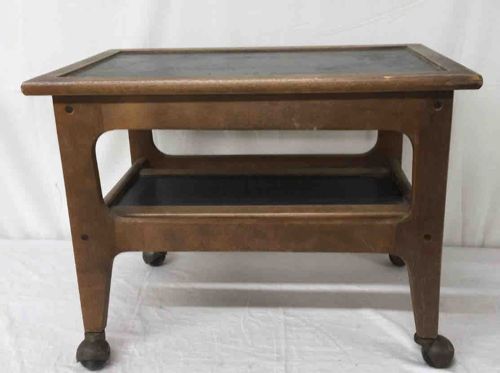
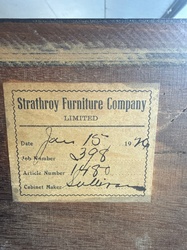
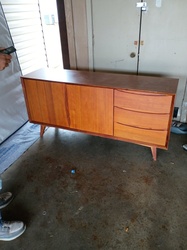
This is a vintage, rectangular, two-tiered wooden utility table that appears primarily constructed from a warm-toned, possibly oak or maple, hardwood. Its dimensions are approximately 26.5 inches in length, 15.75 inches in width, and 20 inches in height. The top surface features a dark, inset panel, likely slate or a similar composition material, framed by the wooden perimeter. A second, identical dark inset panel forms the lower shelf, positioned approximately midway between the tabletop and the floor. The table stands on four sturdy, tapered legs, which are extensions of the side panels. These panels are cut with a graceful, inverted 'U' or arched shape connecting the upper and lower tiers, providing structural integrity and a decorative element. Each leg is fitted with an antique-style, likely metal, caster wheel, indicating its original purpose as a movable piece of furniture, possibly a tea cart, serving cart, or projector stand. The wood exhibits a finished, smooth surface with visible grain patterns. There are some signs of wear consistent with age and use, including minor scuffs, scratches, and possibly a slight dulling of the finish in areas. The dark inset panels show some dust and minor surface imperfections but appear generally intact. The visible joinery seems to be robust, potentially using dowels or screws covered by wood plugs, as indicated by small circular elements on the side panels. There are no obvious manufacturing marks or signatures visible in the provided image. The overall design suggests a functional and durable piece, likely from the early to mid-20th century, perhaps in a Craftsman or utilitarian style.
AI Appraisal Report
Based on my examination of the photographs and owner-provided details, this item is a vintage two-tiered utility table, likely dating from the early to mid-20th century. The piece appears to be constructed from a solid hardwood, possibly oak or maple, with a warm finish. The two dark inset panels, described as possibly slate, are a distinctive feature. The overall design, with its tapered legs, arched side panels, and casters, suggests a functional purpose, such as a tea cart, serving table, or projector stand, embodying a utilitarian or Craftsman-era aesthetic. The condition appears to be good for its age, with minor scuffs, scratches, and wear consistent with normal use. The structural integrity seems intact.
Market comparables for similar mid-century utility or tea carts in good, unrestored condition typically sell in the $75 to $200 range. The use of slate, if confirmed, could place it at the higher end of this estimate. However, the lack of a visible maker's mark or designer attribution limits its value, preventing it from fetching prices associated with notable brands like Heywood-Wakefield or Lane. The primary value driver is its functional and decorative appeal as a solid wood, vintage piece. Authenticity cannot be definitively verified from images alone. A physical inspection would be necessary to confirm the wood type, identify any maker's marks, assess the joinery's stability, and verify the material of the inset panels (e.g., slate vs. laminate), all of which could impact the final valuation.