These notes were written by the person who submitted this item. Appraiser.AI has not verified them, and the AI's identification and estimate may rely on them.
AI Estimated Value
Not an official valuation
$25 - $40
AI estimate as of July 2, 2025 · verify with a professional before acting
AI-Generated · Verify before acting
Everything on this page is generated by AI for informational purposes only. AI can make mistakes — the AI may misidentify items or misattribute them (artist, maker, brand, designer, origin, era). This is not an official valuation and should not be used for insurance, sale, tax, estate, legal, or lending purposes — or any decision requiring a certified appraisal. It is not an authoritative claim about any person, brand, or rights holder — do not share or rely on it as a factual statement about a third party. Always consult qualified professionals before making financial decisions.
This analysis also relies on unverified notes provided by the user, which may be incomplete or inaccurate and could affect the result.
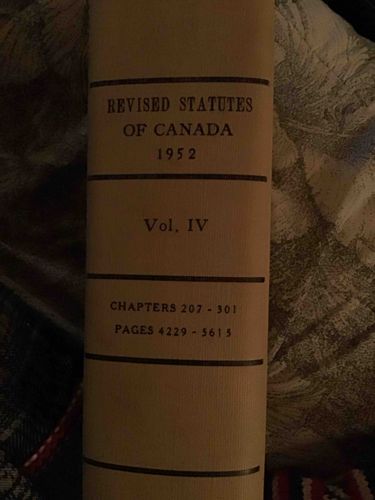
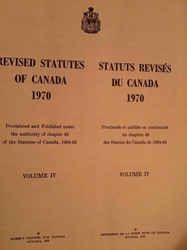
This item is identified as Volume IV of the "Revised Statutes of Canada 1952." It is a legal bound volume, likely a hardcover book, characterized by its beige or light brown spine. The text on the spine is printed in a dark, possibly black or dark brown, sans-serif font, suggesting a functional and clear presentation typical of legal reference materials. Horizontal lines or bands visually separate the different sections of information on the spine, providing a structured appearance. The visible information includes the overarching title "REVISED STATUTES OF CANADA" at the top, followed by the year "1952." Below this, "Vol. IV" clearly indicates it is the fourth volume in the series. Further down, the specific content range is detailed by "CHAPTERS 207 - 301" and corresponding "PAGES 4229 - 5615." The binding appears to be in good condition, with no visible tears, significant scuffs, or major discoloration, consistent with the 'good condition' context provided. The material appears sturdy, indicative of a publication designed for frequent reference and durability. There are no discernible maker's marks or unique decorative elements, which is typical for official government publications. The overall presentation is utilitarian, prioritizing readability and organization, reflecting its function as a comprehensive legal resource from the mid-20th century.
AI Appraisal Report
Upon examining the provided image and the owner's description, I have appraised this 'Revised Statutes of Canada 1952, Vol. IV.' The item's condition is a significant factor. The spine, as described, appears sturdy with clear, legible dark printing on a beige/light brown background. The lack of visible tears, significant scuffs, or major discoloration aligns with the 'good condition' assessment. This utilitarian presentation is typical for legal reference materials, prioritizing function over aesthetics.
Regarding market conditions, vintage legal reference volumes like this generally have a limited, specialized market. Demand primarily comes from legal professionals, libraries, historical institutions, or individuals interested in Canadian legal history. However, the specific demand for a single volume from a complete set, especially one superseded by later revisions, is typically low unless that particular volume contains historically significant legislation. Rarity isn't a major factor here; while first printings of government statutes become scarcer over time, they were produced in large quantities and are not considered rare books.
Factors significantly impacting value include its age, condition, and the limited interest in an incomplete set of superseded legal texts. Most contemporary legal research relies on digital databases, diminishing the practical utility and thus the market value of hard copies. Comparables would include similar individual volumes from the 1950s or 1960s Canadian statutes, which typically sell for modest amounts, often under fifty dollars.
It is crucial to note the limitations of remote appraisal. My assessment of condition is based solely on the provided image and description. Without a physical examination, I cannot confirm the integrity of the binding internally, check for foxing, mold, brittle pages, or any hidden damage. Full authentication would require in-person inspection to verify paper quality, printing methods, and overall structural integrity. Provenance documentation (e.g., prior ownership records) could add minor historical value but is generally not a significant factor for this type of item.