AI Appraisal Estimate

AI-generated estimates · not official valuations

From the user

What was submitted

Photo and notes provided by the user — not generated by AI

Submitted item photo
Submitted photo · May 27, 2026

User's notes

1800-1950

AI analysis below

AI appraisal

AI analysis & estimate

AI-Generated · Verify before acting

Everything below is generated by AI for informational purposes only. AI can make mistakes — the AI may misidentify items or misattribute them (artist, maker, brand, designer, origin, era). This is not an official valuation and should not be used for insurance, sale, tax, estate, legal, or lending purposes — or any decision requiring a certified appraisal. It is not an authoritative claim about any person, brand, or rights holder — do not share or rely on it as a factual statement about a third party. Always consult qualified professionals before making financial decisions.

Note

This analysis also relies on unverified notes provided by the user, which may be incomplete or inaccurate and could affect the result.

Read the full disclaimer

AI Identification

·Not independently authenticated·Verify before acting

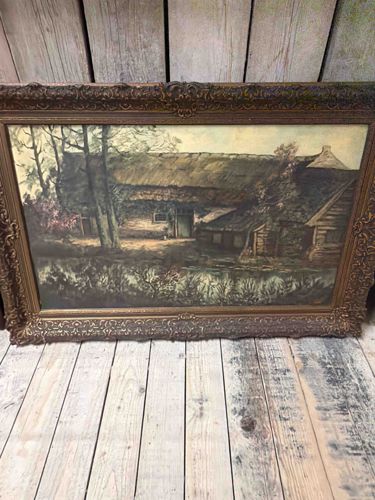
Late 19th or Early 20th Century Cottage Landscape Oil Painting

Fine Art - Paintings

AI Estimated Value

·Not an official valuation·Verify before acting

$1,200 - $1,800

As of May 27, 2026

AI Item Analysis

·AI can make mistakes·Verify before acting
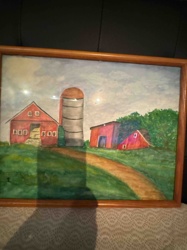
This item is an oil-on-canvas landscape painting housed in an ornate, Victorian-style gilded frame. The artwork depicts a rural scene featuring a thatched-roof cottage or barn nestled among trees, overlooking a body of water or meadow. The palette consists of muted earth tones, moss greens, and soft sky blues, typical of the Barbizon or Impressionist-influenced pastoral styles popular between 1880 and 1920. The construction likely utilizes a wooden stretcher for the canvas. The most prominent feature is the heavy composition frame, which showcases elaborate rococo-inspired scrolled motifs, floral accents, and a beaded inner border. The gilding displays a deep, aged patina with darkened crevices that enhance the texture of the moldings. Visible condition issues include some surface dirt or yellowing of the varnish on the canvas, which is common for its age. The frame shows minor signs of wear, potentially including small chips in the gesso or composition layers consistent with a piece from the late 19th to early 20th century. While a specific signature isn't clearly visible in the provided image, the craftsmanship suggests a professional academic or regional artist of the era. The overall quality is high, particularly in the detailed rendering of the thatched textures and the complex construction of the decorative frame.


AI Appraisal Report

·AI can make mistakes·Verify before acting
I have completed a visual inspection of this late 19th to early 20th-century landscape oil-on-canvas. The work is a quintessential example of the Victorian pastoral tradition, likely produced between 1890 and 1910. The technique displays competent brushwork, particularly in the impasto used for the thatched roof and the atmospheric rendering of the sky, which suggests a student of the Barbizon school or a skilled regional professional. The ornate gilded composition frame is of high quality and appears original to the piece, significantly enhancing its decorative appeal and market value. Condition-wise, the canvas shows a typical aged patina with a yellowed varnish layer that would benefit from a professional cleaning. There is no immediate evidence of major 'craquelure' or canvas sagging, though slight gesso loss is visible on the frame’s decorative scrollwork. Market demand for unsigned cottage landscapes remains steady among interior designers and collectors of traditional Americana and European art, though the lack of a prominent signature limits its ceiling compared to known masters of the era. Limitations: This appraisal is based solely on digital imagery. While the materials appear consistent with the period, I cannot verify the presence of a signature obscured by age or the frame. A physical examination is required to check for underlying signatures, examine the reverse for gallery labels or stamps, and conduct UV/Wood’s lamp testing to identify any previous restoration or over-painting. To fully confirm authenticity and provenance, a search of the stretcher bars for manufacturer marks and a review of any existing sales receipts from the past century would be necessary. Should a signature of a listed artist be discovered under the varnish, the valuation could increase substantially.

Get your items appraised

Instant estimates of your treasures with AI-powered appraisals

Browse More Appraisals