These notes were written by the person who submitted this item. Appraiser.AI has not verified them, and the AI's identification and estimate may rely on them.
AI Estimated Value
Not an official valuation
$150-250
AI estimate as of September 30, 2025 · verify with a professional before acting
AI-Generated · Verify before acting
Everything on this page is generated by AI for informational purposes only. AI can make mistakes — the AI may misidentify items or misattribute them (artist, maker, brand, designer, origin, era). This is not an official valuation and should not be used for insurance, sale, tax, estate, legal, or lending purposes — or any decision requiring a certified appraisal. It is not an authoritative claim about any person, brand, or rights holder — do not share or rely on it as a factual statement about a third party. Always consult qualified professionals before making financial decisions.
This analysis also relies on unverified notes provided by the user, which may be incomplete or inaccurate and could affect the result.
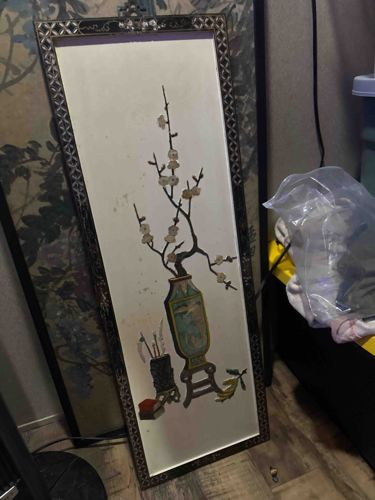
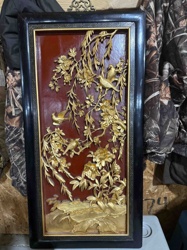
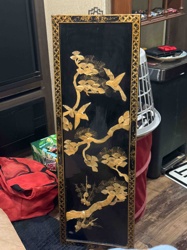
This is a rectangular framed wall panel featuring a decorative arrangement of applied materials, likely stone and mother-of-pearl, on a light-colored surface. The central motif depicts a blossoming branch, possibly plum or cherry, emerging from an elongated, ornate celadon green vase that rests on a stand. To the left of the vase, there's another smaller, dark vessel holding what appear to be paintbrushes or writing implements, and a small red block-like object. The applied materials used for the blossoms appear to be various shades of white, cream, and faint pink, giving a subtle dimension to the scene. The branches are rendered in a dark, possibly carved wood or painted material. The background of the panel is a light, possibly off-white or cream color, which shows some visible discoloration, spotting, and general wear typical of age and exposure. The panel is encased in a dark-colored frame, likely wood, with intricate fretwork or carved geometric patterns (possibly a 'cash' symbol or lattice design) along its inner edge, enhanced with what seems to be mother-of-pearl or inlaid shell accents. The top center of the frame features a small, more elaborate decorative element, possibly a hanger or additional ornamentation. The overall style suggests an East Asian, particularly Chinese, influence, reminiscent of traditional 'hundred antiques' or scholar's desk motifs. The item appears to be an artistic home decor piece, likely from the mid-20th century or earlier, consistent with the 'Ivory dynasty' context, although 'ivory' itself is not clearly discernable within the visible components of the artwork, beyond the light stone/shell materials used for blossoms. The craftsmanship indicates a decorative art piece, possibly mass-produced, but with handmade elements due to the applied materials. There are clear signs of wear, including dust accumulation, surface debris, and potential fading of colors.
AI Appraisal Report
Upon examining the images of this framed Asian decorative wall panel, my assessment is that it is a mid-20th-century piece, likely of Chinese origin, created for the decorative export market. The style, incorporating applied materials like stone and mother-of-pearl to depict a scholarly or 'hundred antiques' motif, was popular during this period. The reference to 'Ivory dynasty' is likely a colloquial or brand name rather than an indication of a specific historical period or the use of genuine ivory, which I do not discern in the photos; the white elements appear to be stone or shell.
The item's condition is fair to good, exhibiting age-appropriate wear such as surface discoloration, spotting on the background fabric, and dust accumulation. The fretwork on the wooden frame shows decent craftsmanship for a decorative item. The primary factors limiting its value are its likely mass-produced nature (though with hand-applied elements) and its current condition. The market for such decorative panels is steady but not exceptionally strong, with comparable pieces often selling in the low to mid-hundreds at auction or in secondary marketplaces. Rarity is low, as many similar panels were produced.
Key value drivers are decorative appeal rather than fine art or antique significance. My valuation of $150-250 reflects its standing as an attractive vintage decorative object. It's important to note the limitations of a digital appraisal. A physical, in-person examination would be required to positively identify the specific types of stone and materials used, assess the structural integrity of the frame and panel, and look for any maker's marks or signatures that are not visible in the images. Without this direct inspection or provenance documentation, a definitive authentication or attribution is not possible.