AI estimate as of July 7, 2025 · verify with a professional before acting
AI-Generated · Verify before acting
Everything on this page is generated by AI for informational purposes only. AI can make mistakes — the AI may misidentify items or misattribute them (artist, maker, brand, designer, origin, era). This is not an official valuation and should not be used for insurance, sale, tax, estate, legal, or lending purposes — or any decision requiring a certified appraisal. It is not an authoritative claim about any person, brand, or rights holder — do not share or rely on it as a factual statement about a third party. Always consult qualified professionals before making financial decisions.
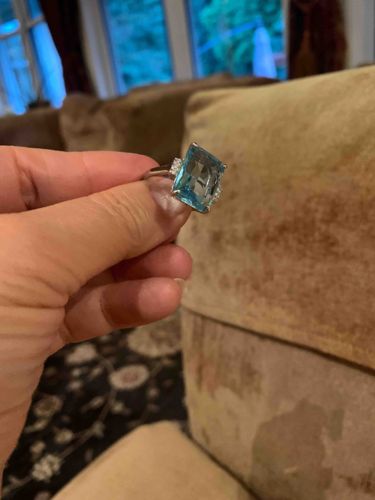
This is a statement cocktail ring featuring a prominent, rectangular cut gemstone, likely an aquamarine, given its clear light blue hue. The main stone is facet-cut, exhibiting multiple facets that catch and refract light, suggesting a high degree of brilliance. Its shape is an emerald or step-cut, which highlights the clarity and color of the stone. The ring's setting appears to be made of a silver-toned metal, possibly white gold, platinum, or sterling silver, indicative of quality craftsmanship. Flanking the central large stone on each side are smaller, brilliant-cut stones, which appear to be diamonds or diamond simulants, contributing additional sparkle. There are approximately 3 to 5 smaller stones on each side, set closely together, possibly in a pavé or channel setting. The band itself is thin and complements the substantial top of the ring. No specific maker's marks or signatures are visible in the image. The overall condition appears to be good with no obvious signs of significant damage like chips, cracks, or heavy wear on the visible surfaces of the stones or metal. The metal shows a clean, polished finish. The design suggests a relatively modern or contemporary style, possibly dating from the late 20th to early 21st century. The quality of the stone's cut and the surrounding accent stones suggest a well-made, elegant piece suitable for formal occasions or as a fashion statement.
AI Appraisal Report
Upon visual examination of the provided image, I assess this aquamarine and diamond-accented cocktail ring to be in good condition. The large rectangular cut gemstone, likely aquamarine due to its clear light blue hue and facet-cut brilliance, exhibits no obvious chips or abrasions. The surrounding smaller, brilliant-cut stones, highly probable diamonds or high-quality simulants, appear intact and securely set. The silver-toned metal, presumably white gold or platinum given the overall quality, shows a clean, polished finish without visible damage or excessive wear.
Authenticity of the gemstones and metal cannot be definitively confirmed from an image alone. The 'diamonds' could be simulants such as moissanite or cubic zirconia, which would significantly impact the value. Similarly, the 'aquamarine' could be a treated topaz or synthetic spinel. The metal composition also requires testing.
Considering current market conditions for similar aquamarine and diamond cocktail rings, with genuine stones and precious metal, and assuming the craftsmanship appears to be of good quality, they typically retail between $1,500 and $3,500, depending heavily on the carat weight and quality of the main aquamarine and the accent diamonds. There is a consistent demand for substantial colored gemstone rings, especially those with good clarity and vibrant color like this piece.
Factors significantly impacting value include the precise carat weight and clarity of the aquamarine, the total carat weight and quality (cut, color, clarity) of the accent diamonds, and the metal purity. Without clear hallmarks or laboratory reports, the origin and quality are assumptions.
For full authentication and a precise valuation, an in-person examination is crucial. This would involve gemstone testing (refractive index, specific gravity, spectroscopy), diamond grading, metal assay, and weighing the piece. Provenance documentation, if available, would further enhance certainty regarding its history and authenticity.