AI estimate as of November 4, 2025 · verify with a professional before acting
AI-Generated · Verify before acting
Everything on this page is generated by AI for informational purposes only. AI can make mistakes — the AI may misidentify items or misattribute them (artist, maker, brand, designer, origin, era). This is not an official valuation and should not be used for insurance, sale, tax, estate, legal, or lending purposes — or any decision requiring a certified appraisal. It is not an authoritative claim about any person, brand, or rights holder — do not share or rely on it as a factual statement about a third party. Always consult qualified professionals before making financial decisions.
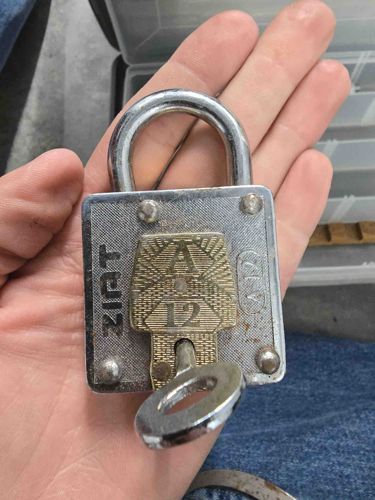
This is a vintage Ziat padlock, likely made of a nickel-plated or chrome-plated brass or steel body, featuring a distinctive square shape with rounded corners. The main body of the padlock exhibits a textured, possibly pebbled or hammered, finish on its surface, contrasting with the smooth, shiny, and somewhat worn plating of the U-shaped shackle and the inserted key. The padlock measures approximately 2-3 inches in width, fitting comfortably in the palm of a hand. Four prominent rivets are visible on the front face, securing the internal mechanism or casing. The brand name "ZIAT" is vertically embossed or stamped on the left side of the lock's face. A central, recessed keyhole cover or escutcheon is present, rendered in a brassy or gold-toned metal, featuring a stylized 'A' at the top, radiating lines, and the number '12' clearly inscribed below it. To the right of this central feature, the text "A 12" is also embossed, matching the marking on the keyhole cover. The key, which is currently inserted into the keyhole, has a silver-toned finish with a larger, flattened oval bow for grip. The overall condition shows signs of age and use, including minor scratches, scuffs, and some tarnishing or loss of plating, particularly around the edges and on the shackle. The textured surface of the lock body still retains much of its original appearance, suggesting decent craftsmanship for its intended purpose. The specific 'A 12' markings likely indicate a key code or series, common in master-keyed or keyed-alike padlock sets. The design, particularly the font and the patterned keyhole cover, suggests a mid-20th-century style.
AI Appraisal Report
Upon examining the images provided, I can assess this item as a vintage Ziat padlock, designated with the 'A 12' key code. The lock appears to be of mid-20th-century origin, likely constructed from a plated base metal such as brass or steel. Visible characteristics like the textured body, riveted construction, and distinctive embossed markings are consistent with Ziat padlocks from this era. The overall condition is fair to good for its age, showing expected wear including scratches, scuffs, and minor loss of the nickel or chrome plating on the shackle and key. The presence of the original matching key is a significant positive factor for its value.
From a market perspective, Ziat is a known but not exceptionally rare brand among lock collectors. Similar vintage padlocks from this period, in comparable condition and with their original keys, typically trade in a modest price range. The 'A 12' marking suggests it may have been part of a keyed-alike or master-keyed system, which is interesting but does not dramatically elevate its value over a standard individually keyed lock. Its primary value driver is its decorative quality and appeal to collectors of vintage hardware and locks, rather than high rarity or precious metal content.
My valuation is based on recent sales of comparable Ziat and other mid-century industrial padlocks on online auction sites and collector forums. It's important to note that this appraisal is based solely on visual inspection of images. I cannot definitively verify the lock's functionality, confirm the base metal composition, or rule out a later reproduction without a physical examination. A hands-on inspection would be required to test the mechanism and assess the weight and material quality, which could slightly adjust the final value.