AI Appraisal Estimate

AI-generated estimates · not official valuations

From the user

What was submitted

Photo and notes provided by the user — not generated by AI

Submitted item photo
Submitted photo · June 3, 2026

User's notes

No additional notes provided.

AI analysis below

AI appraisal

AI analysis & estimate

AI-Generated · Verify before acting

Everything below is generated by AI for informational purposes only. AI can make mistakes — the AI may misidentify items or misattribute them (artist, maker, brand, designer, origin, era). This is not an official valuation and should not be used for insurance, sale, tax, estate, legal, or lending purposes — or any decision requiring a certified appraisal. It is not an authoritative claim about any person, brand, or rights holder — do not share or rely on it as a factual statement about a third party. Always consult qualified professionals before making financial decisions.

Read the full disclaimer

AI Identification

·Not independently authenticated·Verify before acting

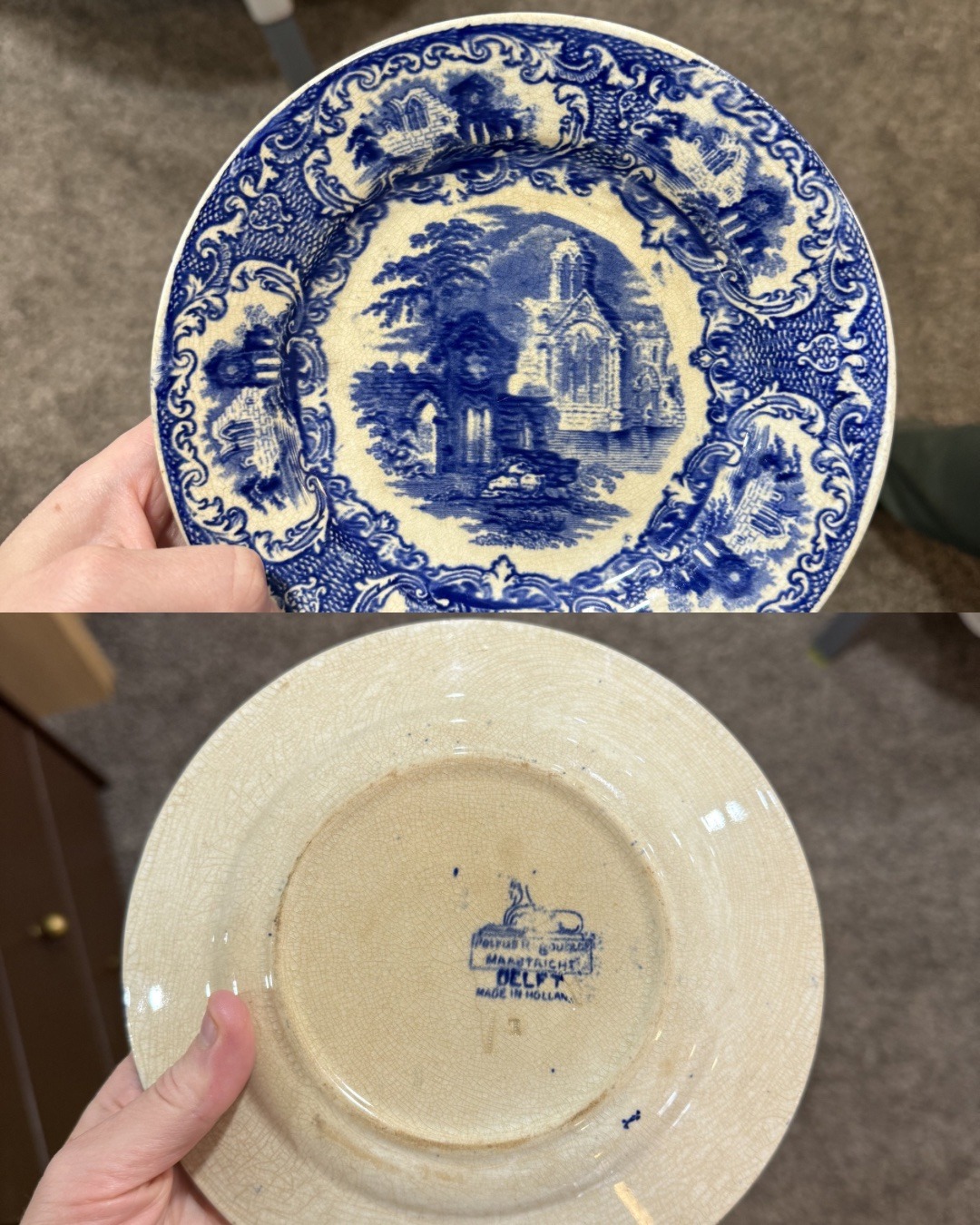
Petrus Regout & Co. Maastricht 'Delft' Pattern Blue and White Transferware Plate

Antique Ceramics and Pottery

AI Estimated Value

·Not an official valuation·Verify before acting

$25 - $45

As of June 3, 2026

AI Item Analysis

·AI can make mistakes·Verify before acting
This is a vintage ceramic plate produced by Petrus Regout & Co. in Maastricht, Holland. The plate features a classic blue and white transferware design in the 'Delft' pattern, which depicts a romanticized landscape of architectural ruins, Gothic-style windows, and lush trees. The central scene is framed by an elaborate border consisting of repeating scrollwork, foliate motifs, and vignettes of further ruins and landscape elements over a stippled background. The plate is constructed from thick earthenware (creamware) with a characteristic off-white glaze. On the reverse, the piece bears a clear blue backstamp featuring the company's trademark sphinx logo over a rectangle, with the text 'PETRUS REGOUT & CO', 'MAASTRICHT', 'DELFT', and 'MADE IN HOLLAND'. Based on the backstamp style, this likely dates to the late 19th century or very early 20th century (circa 1890-1910). The condition shows significant age-related wear, most notably heavy, all-over crazing (fine network of cracks in the glaze) and visible yellowing or staining of the body, particularly on the underside. There is also moderate 'wear-and-tear' discoloration around the unglazed foot rim and a few small blue ink transfer specks. The craftsmanship is typical of high-volume industrial ceramic production of the period, demonstrating the enduring popularity of the Dutch transferware style.
AI Appraisal Report

·AI can make mistakes·Verify before acting
Based on my visual examination of the provided descriptions and photographic evidence, I have assessed this Petrus Regout & Co. transferware plate in the 'Delft' pattern. The backstamp, featuring the sphinx logo and 'Made in Holland' text, confirms its origin in Maastricht and suggests a manufacturing date between 1890 and 1910. While the transfer application is crisp and the pattern is a classic example of Dutch industrial production, the condition is a significant limiting factor. The heavy, all-over crazing and noticeable yellowing/staining indicate that the earthenware body has absorbed moisture and organic matter over time, which detracts from its aesthetic and structural integrity. In the current market, Maastricht transferware of this era is relatively common. While there is a steady interest in late 19th-century blue and white ceramics, collectors typically prioritize 'near-mint' examples. Similar plates in excellent condition rarely exceed $60; given the visible staining and crazing on this piece, it sits at the lower end of the valuation spectrum. The value is primarily decorative rather than as a high-investment specimen. Limitations: This appraisal is based solely on digital images. A physical inspection is necessary to check for hidden hairline cracks (resonance test), professional restorations, or 'flea bites' along the rim that may not be visible. Full authentication would ideally include provenance documentation or an in-person assessment of the glaze’s tactile quality. Scientific testing is generally not required for pieces of this era unless toxic lead-leaching is a concern for functional use.

Get your items appraised

Instant estimates of your treasures with AI-powered appraisals

Browse More Appraisals