AI estimate as of December 14, 2025 · verify with a professional before acting
AI-Generated · Verify before acting
Everything on this page is generated by AI for informational purposes only. AI can make mistakes — the AI may misidentify items or misattribute them (artist, maker, brand, designer, origin, era). This is not an official valuation and should not be used for insurance, sale, tax, estate, legal, or lending purposes — or any decision requiring a certified appraisal. It is not an authoritative claim about any person, brand, or rights holder — do not share or rely on it as a factual statement about a third party. Always consult qualified professionals before making financial decisions.
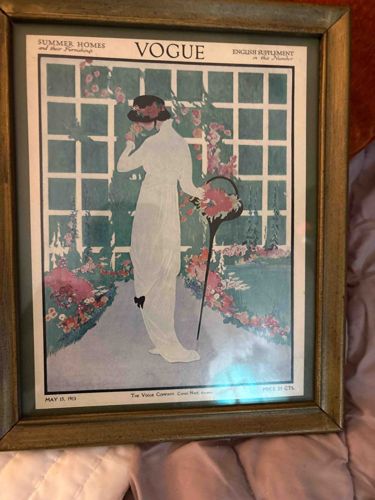
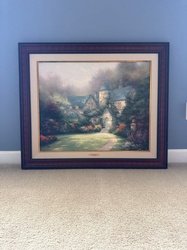
This item is a framed print of a vintage Vogue magazine cover, specifically dated May 15, 1913. The print features an elegant illustration dominated by a female figure in a white, flowing gown, seen from the back in a garden setting. She is wearing a dark hat adorned with pink flowers and appears to be smelling a blossom held to her nose, while holding a basket filled with similar pink flowers in her left hand. The background consists of a green trellis or lattice structure, lush with pink and green floral arrangements. The top of the print clearly displays 'VOGUE' in large black capital letters, with 'SUMMER HOMES and Their Furnishings' to the left and 'ENGLISH SUPPLEMENT in This Number' to the right. The bottom left corner bears the date 'MAY 15, 1913', and a faint line of text in the lower center likely reads 'The Vogue Company, Condé Nast, Publishers'. The print is housed in a simple rectangular wooden frame with a somewhat distressed, possibly bronze or antique gold finish. The overall condition of the print within the frame appears to be good, with no obvious major damage, tears, or significant discoloration visible, although some glare from the protective glass makes a full assessment difficult. The frame itself shows some minor wear consistent with age, particularly at the corners and edges. The print captures the distinctive Art Nouveau or early Art Deco aesthetic prevalent in the early 20th century, characterized by natural forms and elegant lines. This type of decorative print is typically sought after for its historical fashion significance and aesthetic appeal, often used for wall decor.
AI Appraisal Report
Based on my visual examination of the provided image, this Framed Vintage Vogue Magazine Cover Print, May 15, 1913 - 'Summer Homes', presents as a decorative reproduction. The print itself appears to be in good condition, exhibiting the characteristic Art Nouveau/early Art Deco aesthetics of the period. The colors seem vibrant, and damage like tears or significant discoloration is not apparent, though glare makes a definitive assessment of the print's surface impossible. The simple wooden frame with a distressed finish shows minor wear, which is consistent with its age or style. While the print captures the essence of a historical Vogue cover, it is highly improbable that this is an original magazine page. Original magazine pages from this era, especially full covers, are considerably rarer and more delicate, often showing more signs of age, creasing, or binding marks. This item is typical of widely reproduced vintage magazine covers sold as decorative art.
Market comparables for framed reproductions of vintage Vogue covers of this era generally fall within the $75 to $150 range, depending on the quality of the print, the framing, and the specific image's popularity. Demand for these decorative prints is consistent; they are sought after for their aesthetic and historical appeal in home decor, rather than as investment-grade collectibles. The Art Nouveau style and the iconic 'VOGUE' branding contribute to its desirability.
Limitations in authenticity verification are significant based on images alone. I can confirm this is a print of a Vogue cover from the specified date. However, without in-person inspection, I cannot definitively confirm if it is an original page, a high-quality contemporary reproduction, or a more recent digital print. An in-person examination would allow for closer inspection of the paper quality, printing technique (e.g., halftone dots, paper fiber), edge condition, and the presence of any binding marks to determine if it truly originated from a bound magazine. Provenance documentation, such as receipts or exhibition history, would also strengthen any claims of higher value. Scientific testing, like paper analysis, would be required for absolute authentication of its period-correctness as an original magazine page.