AI estimate as of October 25, 2025 · verify with a professional before acting
AI-Generated · Verify before acting
Everything on this page is generated by AI for informational purposes only. AI can make mistakes — the AI may misidentify items or misattribute them (artist, maker, brand, designer, origin, era). This is not an official valuation and should not be used for insurance, sale, tax, estate, legal, or lending purposes — or any decision requiring a certified appraisal. It is not an authoritative claim about any person, brand, or rights holder — do not share or rely on it as a factual statement about a third party. Always consult qualified professionals before making financial decisions.
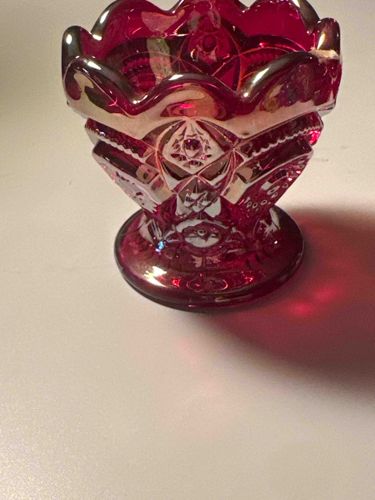
This item is a ruby red carnival glass footed candy dish or small compote, characterized by its vibrant, translucent deep red color that exhibits an iridescent sheen, typical of carnival glass, particularly noticeable around the rim and raised exterior patterns. The dish stands on a short, circular pedestal base, which is also ruby red glass. The body of the dish is bowl-shaped, with a distinct flared and ruffled or scalloped rim. The exterior of the bowl section is heavily molded and embossed with a striking geometric and floral pattern. This pattern includes diamond-shaped facets interspersed with starburst or floral motifs, creating a visually complex and textured surface. The craftsmanship suggests it was pressed glass, a common method for producing carnival glass. The condition appears to be good with no obvious chips or cracks visible from the image, but specific surface wear or internal flaws cannot be fully assessed without closer inspection. The iridescent effect indicates a post-production treatment or a specific composition of the glass to achieve this lustrous finish. This type of glass was popular from the early 20th century, typically dating from the 1900s to the 1930s, often produced by American manufacturers. The intricate pattern work and vibrant color are indicators of decorative intent and skilled glass molding.
AI Appraisal Report
I have examined the image of this Ruby Red Carnival Glass Footed Candy Dish or Compote. Visually, the piece presents as authentic carnival glass, characterized by its deep red hue and iridescent sheen, particularly evident on the rim and raised patterns. The ruffled rim and heavily molded geometric and floral patterns are consistent with pressed glass techniques common to early 20th-century American carnival glass production. The condition appears to be good based on the image, with no visible chips or cracks; however, a thorough in-person inspection would be needed to assess minor surface wear, internal flaws, or potential repairs that are not discernible from photographs alone.
Market conditions for carnival glass, while stable, are not as robust as they once were. Ruby red carnival glass is generally desirable, but the value is highly dependent on patterns, makers, and rarity. This specific pattern, while attractive, does not immediately identify it as a highly sought-after or rare mold from a premium manufacturer without further research. Comparables for similar ruby red carnival glass compotes or candy dishes in good condition typically fall within the $40-$75 range. Demand tends to come from collectors of specific patterns or styles, or those looking for decorative period pieces. The lack of visible maker's marks is common for carnival glass but limits definitive authentication of the manufacturer, which could impact value if it were a rare product from a top-tier producer.
Factors significantly impacting value include pattern rarity, manufacturer (e.g., Fenton, Imperial, Northwood), and impeccable condition. To confirm authenticity definitively and assess full condition, a physical examination under varying light conditions, coupled with blacklight testing for repairs and a detailed pattern identification against known carnival glass catalogs, would be crucial. Provenance documentation, though rare for everyday carnival glass, would also add value.