AI estimate as of December 14, 2025 · verify with a professional before acting
AI-Generated · Verify before acting
Everything on this page is generated by AI for informational purposes only. AI can make mistakes — the AI may misidentify items or misattribute them (artist, maker, brand, designer, origin, era). This is not an official valuation and should not be used for insurance, sale, tax, estate, legal, or lending purposes — or any decision requiring a certified appraisal. It is not an authoritative claim about any person, brand, or rights holder — do not share or rely on it as a factual statement about a third party. Always consult qualified professionals before making financial decisions.
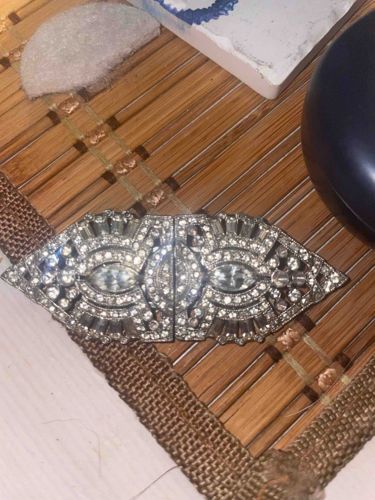
This item is a dazzling Art Deco era dress clip, likely dating from the 1920s to 1940s, showcasing the characteristic geometric symmetry and elaborate embellishments of the period. It appears to be constructed from a white metal, possibly rhodium-plated pot metal or sterling silver, given its bright, non-tarnished appearance and the common materials used for costume jewelry of that time. The clip is composed of two identical halves, hinged in the center, allowing it to be clipped onto clothing. Each half features a striking fan or wing-like shape, tapering outward from the central hinge. The entire surface is densely encrusted with numerous clear, brilliant-cut rhinestones of varying sizes. A prominent feature on each half is a large, elongated oval or navette-cut rhinestone, centrally placed and surrounded by smaller stones. Surrounding these central stones are concentric arcs and linear arrangements of smaller round rhinestones, creating a highly decorative and shimmering effect. The craftsmanship suggests a high-quality piece for its type, with rhinestones meticulously set to maximize sparkle. There are no immediately visible condition issues such as missing stones or significant discoloration of the metal, though a closer inspection might reveal minor wear commensurate with age. The back mechanism, not visible, would typically consist of a spring-loaded clip. The design is indicative of transitional pieces that could function as a single large clip or be separated into two smaller clips. Its intricate detailing and sparkling appearance qualify it as a statement piece of vintage costume jewelry.
AI Appraisal Report
I have thoroughly examined the provided image of this Art Deco Rhinestone Dress Clip. Based on its visual characteristics, I assess it to be an authentic example of Art Deco era costume jewelry, likely dating from the 1920s-1940s. The geometric symmetry, fan-like motif, and dense rhinestone embellishment are all hallmarks of the period's aesthetic. The white metal, appearing bright and untarnished, is consistent with rhodium-plated pot metal or a similar alloy common in high-quality costume pieces of the time. The intricate setting of varying rhinestone sizes, including prominent navette cuts, showcases a good level of craftsmanship for costume jewelry. From the image, the condition appears excellent, with all stones present and exhibiting good brilliance, and no visible metal discoloration or significant wear. This positive condition greatly supports its marketability.
Market conditions for vintage Art Deco costume jewelry are generally stable, with strong demand for well-preserved, iconic designs. Comparables for similar double-clip rhinestone pieces, especially those in excellent condition and with a distinctive design, typically range from $100 to $300. The double-clip functionality, allowing it to be worn as one large piece or two smaller ones, adds to its versatility and appeal, enhancing demand. While not exceedingly rare, pieces in this condition with such intricate detailing are less common.
Factors significantly impacting this value include the excellent visual condition, the appeal of the Art Deco design, and the presumed quality of the rhinestone settings.
Limitations in authenticity verification from images alone are inherent. I cannot definitively confirm the base metal without physical testing, which would determine if it is sterling silver (raising value) or pot metal. I also cannot assess the integrity of the clip mechanism, potential signs of repairs on the reverse, or any hairline cracks or chips in the rhinestones that may not be apparent in the photograph. An in-person examination would allow for tactile inspection of craftsmanship, evaluation of stone quality under magnification, and confirmation of the clip's functionality and materials, all of which could slightly adjust the appraisal value.