AI estimate as of June 14, 2025 · verify with a professional before acting
AI-Generated · Verify before acting
Everything on this page is generated by AI for informational purposes only. AI can make mistakes — the AI may misidentify items or misattribute them (artist, maker, brand, designer, origin, era). This is not an official valuation and should not be used for insurance, sale, tax, estate, legal, or lending purposes — or any decision requiring a certified appraisal. It is not an authoritative claim about any person, brand, or rights holder — do not share or rely on it as a factual statement about a third party. Always consult qualified professionals before making financial decisions.
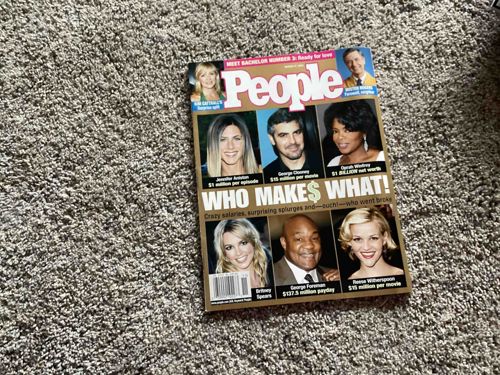
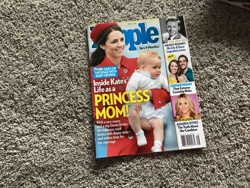
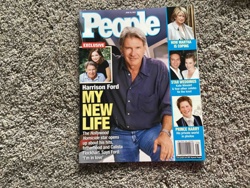
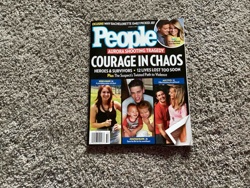
The object is a copy of People magazine. The cover features a collage of prominent celebrities, including Jennifer Aniston, George Clooney, Oprah Winfrey, Britney Spears, George Foreman, and Reese Witherspoon. The main headline reads "WHO MAKES WHAT!" with a subtitle about "Crazy salaries, surprising splurges and—ouch!—who went broke." Below each celebrity's image is their name and a related financial detail or earning. The masthead at the top clearly states "People" in large pink lettering, with a smaller headline above it mentioning "MEET BACHELOR NUMBER 3: Ready for love". A photograph of a person in a suit appears next to the "People" logo, possibly related to the Bachelor article. The magazine appears to be a standard size for a weekly publication of this type, likely printed on glossy paper. The edges of the magazine show minor wear, consistent with being handled. A barcode is visible in the lower left corner. There are no visible tears or significant creases on the main cover. The overall impression is that of a used, but relatively well-preserved, copy of a popular entertainment magazine. The style and featured celebrities place this magazine likely in the early to mid-2000s.
AI Appraisal Report
Upon examining the provided image of the People magazine dated from the early to mid-2000s, featuring the 'WHO MAKES WHAT!' cover with celebrities like Jennifer Aniston, George Clooney, and Oprah Winfrey, I assess its condition as good, exhibiting minor surface wear and edge handling commensurate with typical use for a magazine of this age. There are no apparent tears or major creases on the cover, and the colors appear generally unfaded based on the image. Authenticity as a genuine copy of People magazine from that era is readily confirmed by the masthead, content style, and visible barcode typical of the publication. However, definitive authenticity regarding any potential alterations beyond normal use cannot be fully verified from images alone; an in-person examination would allow for tactile inspection of paper quality, binding integrity, and microscopic analysis for any signs of repair or tampering.
Market conditions for mass-produced entertainment magazines from this period are generally low unless featuring a highly iconic or controversial cover moment or a celebrity with exceptional enduring collectibility or historical significance. While the featured celebrities are well-known, this particular 'WHO MAKES WHAT!' theme is not typically sought after by collectors beyond interest in the specific issue's content. Comparable sales of standard People issues from this era typically range from a few dollars to perhaps ten dollars depending on specific cover appeal and point of sale (flea market vs. online auction). Demand is limited to individuals interested in the specific cultural snapshot or perhaps a fan of one of the featured celebrities.
Factors impacting value are primarily the condition and the relatively common nature of the item. Rarity is not a factor as this was a mass-market periodical. Without physical inspection to confirm condition details like spine integrity, internal page condition, and to rule out hidden damage or odors, the value must be based solely on the visible cover which appears to be in good, used condition.
For full authentication and condition assessment, an in-person inspection is necessary to examine the interior, spine, staples, paper quality, and detect any signs of moisture damage, odor, or other condition issues not visible in the image. Provenance documentation, while helpful for collectible items, is not typically pursued for standard magazines of this type.