AI estimate as of July 27, 2025 · verify with a professional before acting
AI-Generated · Verify before acting
Everything on this page is generated by AI for informational purposes only. AI can make mistakes — the AI may misidentify items or misattribute them (artist, maker, brand, designer, origin, era). This is not an official valuation and should not be used for insurance, sale, tax, estate, legal, or lending purposes — or any decision requiring a certified appraisal. It is not an authoritative claim about any person, brand, or rights holder — do not share or rely on it as a factual statement about a third party. Always consult qualified professionals before making financial decisions.
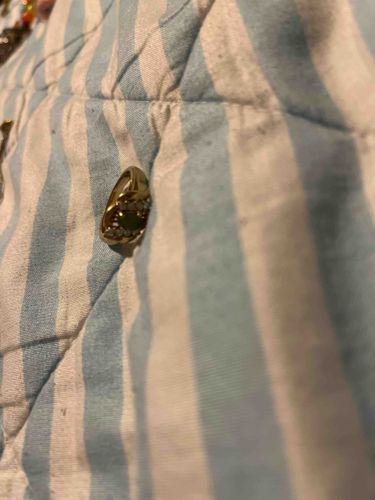
The item appears to be a vintage or antique cocktail ring, likely crafted from yellow gold or a gold-tone base metal, given its warm metallic color. The central feature is an oval-shaped cabochon gemstone, which, based on its deep, rich green hue and smooth, polished surface, is likely jade or a similar green gemstone like chrysoprase or aventurine. This central stone is bezel-set or semi-bezel-set within the metal band. Flanking the central green stone are multiple smaller, clear, round faceted stones, possibly diamonds or cubic zirconia, set into the metalwork. These smaller stones exhibit some sparkle, suggesting they are either good quality simulants or genuine gemstones that could benefit from cleaning to enhance their brilliance. The overall design features a gently twisted or undulating band on either side of the central setting, creating an elegant, somewhat organic flow. The metal shows some signs of wear, including minor surface scratches and possibly some tarnish or dirt buildup in the crevices, consistent with age and regular use. There are no immediate visible hallmarks or manufacturer's stamps from the provided image, which would typically be found on the inside of the band. The craftsmanship appears to be of decent quality, with the stones well-seated, though the exact setting type for the smaller stones is difficult to ascertain precisely. The ring's design suggests a mid-20th century to late-20th century aesthetic, possibly falling into the Art Deco revival, Retro, or mid-century modern periods, given its blend of classic and slightly bolder elements. The visible condition suggests it has been worn but is generally intact, with no obvious major damage like missing stones or significant structural deformation.
AI Appraisal Report
Upon visual examination of the provided image, I assess this yellow gold tone ring with a green cabochon and clear accent stones. The piece appears to be a vintage cocktail ring, likely from the mid to late 20th century, given its design aesthetic. The central oval cabochon, with its deep green hue and smooth surface, strongly suggests it is jade or a high-quality simulant like chrysoprase or aventurine. This stone is securely set, likely bezel or semi-bezel. The surrounding clear accent stones are round faceted cuts, exhibiting sparkle consistent with either diamonds or cubic zirconia. While they appear well-seated, their brilliance could be enhanced with cleaning.
The metal, appearing as yellow gold tone, shows superficial wear, including minor scratches and some potential tarnish, which is expected for an item of its presumed age and consistent use. The gently twisted band design adds an elegant touch. No hallmarks are visible in the image, which is a significant limitation for authentication. The craftsmanship appears decent; however, without a physical inspection, I cannot confirm the exact setting type for all stones or the metal's fineness.
Market conditions for vintage jewelry, especially pieces with a classic aesthetic like this, remain steady. Comparables would include similar cocktail rings featuring genuine green gemstones or high-quality simulants. Demand is moderate, driven by collectors and those seeking unique vintage pieces. The primary factors impacting value are the authenticity and quality of the central green stone, the identity of the clear accent stones (diamond vs. simulant), and the metal content (solid gold vs. plated/gold-fill).
Limitations are significant due to image-only examination. I cannot definitively ascertain the authenticity of the green or clear stones (e.g., natural jade/diamond vs. simulant/lab-created), nor the metal's composition (e.g., 14k gold vs. gold-filled base metal). For full authentication and a precise valuation, an in-person examination is crucial. This would involve specific gravity tests and refractive index measurements for gemstones, metal purity testing (e.g., XRF analysis), and a thorough inspection for hallmarks or manufacturer's marks.