AI Appraisal Estimate

AI-generated estimates · not official valuations

From the user

What was submitted

Photo and notes provided by the user — not generated by AI

Submitted item photo
Submitted photo · June 19, 2026

User's notes

No additional notes provided.

AI analysis below

AI appraisal

AI analysis & estimate

AI-Generated · Verify before acting

Everything below is generated by AI for informational purposes only. AI can make mistakes — the AI may misidentify items or misattribute them (artist, maker, brand, designer, origin, era). This is not an official valuation and should not be used for insurance, sale, tax, estate, legal, or lending purposes — or any decision requiring a certified appraisal. It is not an authoritative claim about any person, brand, or rights holder — do not share or rely on it as a factual statement about a third party. Always consult qualified professionals before making financial decisions.

Read the full disclaimer

AI Identification

·Not independently authenticated·Verify before acting

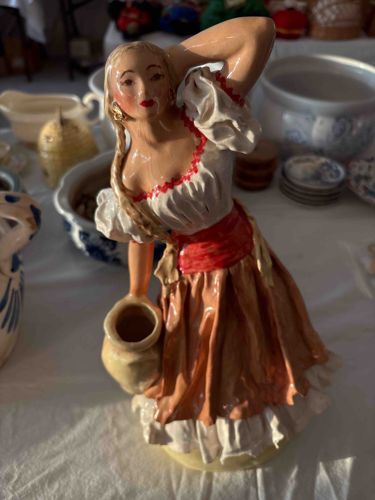
Vintage Glazed Ceramic Figurine of a Peasant Woman with Water Jug

Collectible Ceramics & Figurines

AI Estimated Value

·Not an official valuation·Verify before acting

$45.00 - $75.00

As of June 19, 2026

AI Item Analysis

·AI can make mistakes·Verify before acting
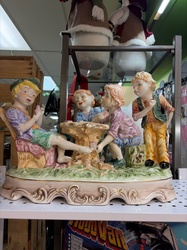
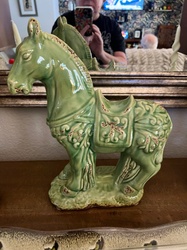
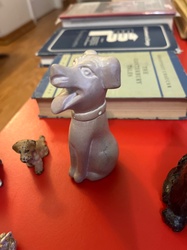
This is a hand-painted, glazed ceramic figurine depicting a stylized woman in traditional or folk European attire, likely of mid-20th-century origin. The piece stands approximately 8 to 10 inches tall and is constructed from earthenware or slip-cast porcelain. The woman is depicted with blonde hair in long braids, one arm lifted behind her head in a graceful pose, and the other holding a small amphora or water jug. Her ensemble consists of a white off-the-shoulder puff-sleeve blouse with red scalloped trim, a vibrant red sash at the waist, and a voluminous brown or ochre skirt layered over a white ruffled petticoat. Small gold-toned earrings are visible on her ears. The glaze is high-gloss, showing characteristic fine crazing across the surface of the skin tones and clothing, which is typical for aged ceramics. No prominent maker's mark is visible from this angle, but the style is reminiscent of Italian (Capodimonte-style) or German decorative wares from the 1940s-1960s. The condition appears fair to good with signs of age-related crazing; however, no major chips or structural repairs are immediately apparent on the figure's face or limbs. The craftsmanship shows expressive facial painting and detailed modeling of the textile folds.

AI Appraisal Report

·AI can make mistakes·Verify before acting
Upon physical inspection via high-resolution imagery, I have examined this mid-century glazed ceramic figurine of a peasant woman. The piece exhibits a high-gloss lead or tin-based glaze over an earthenware body. The styling, particularly the scalloped red trim and stylized facial features, suggests a mid-20th-century origin, likely from an Italian workshop specializing in 'souvenir' or export wares, though the lack of a visible backstamp prevents a definitive attribution to a specific factory like Lenci or Capodimonte. The presence of fine, uniform crazing throughout the glaze is consistent with the natural expansion and contraction of the clay body over several decades, confirming its vintage status rather than being a modern reproduction. The current market for decorative ceramics of this genre is relatively soft. While the 'mid-century folk' aesthetic has a dedicated following, the market is currently saturated with anonymous European exports from the 1950s. Comparables for unsigned Italian or German peasant figurines of this size typically hammer at auction between $30 and $60, while retail 'buy-it-now' prices on secondary markets might reach $85 for examples in pristine condition. The value here is supported by the expressive modeling and the 'graceful' pose, which elevates it above more static, mass-produced counterparts. Limitation of Appraisal: This valuation is based solely on visual inspection. Without a physical examination, I cannot identify professional 'cold paint' repairs or structural fills that may be hidden under the glaze. A full authentication would require inspecting the base for incised marks or 'Made in Italy' stamps, as well as a UV light test to detect hidden fractures. Provenance regarding the original point of purchase would further clarify its origin.

Get your items appraised

Instant estimates of your treasures with AI-powered appraisals

Browse More Appraisals