AI estimate as of August 25, 2025 · verify with a professional before acting
AI-Generated · Verify before acting
Everything on this page is generated by AI for informational purposes only. AI can make mistakes — the AI may misidentify items or misattribute them (artist, maker, brand, designer, origin, era). This is not an official valuation and should not be used for insurance, sale, tax, estate, legal, or lending purposes — or any decision requiring a certified appraisal. It is not an authoritative claim about any person, brand, or rights holder — do not share or rely on it as a factual statement about a third party. Always consult qualified professionals before making financial decisions.
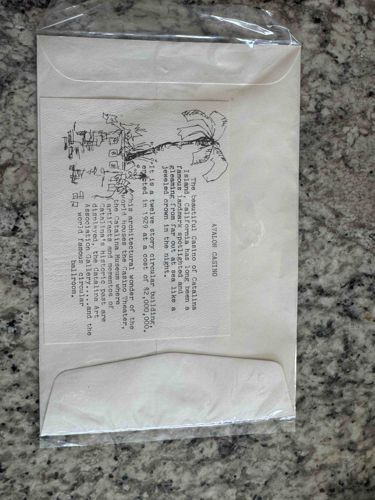
This item is a commercially produced postcard or greeting card, still sealed in its original clear plastic packaging. The card itself appears to be a light-colored, possibly off-white or cream, paper stock. On the visible portion, there is a black and white line drawing of a building with a tall, slender structure, resembling a palm tree, next to it. Text is printed beside the drawing, identifying the subject as the 'AVALON CASINO' on Catalina Island, California. The text describes the casino as a 'twelve-story circular building,' 'erected in 1929 at a cost of $2,000,000' (note: OCR indicates '1979,' but historical knowledge confirms the casino was built in 1929, suggesting a historical typo or misprint in the image's text). It further notes that the building houses the Casino Theater, Catalina Museum, Catalina Art Association Gallery, and a 'world famous circular ballroom.' The card is preserved in its original clear plastic sleeve, which has some minor creasing, but the card inside appears to be in excellent, untouched condition. The edges of the paper card are clean and sharp, indicating no wear or damage. The back of the card, or the inside if it's a folded greeting card, is not visible. This item is likely a souvenir from Catalina Island, probably produced in the mid-to-late 20th century given the printing style and the type of information presented. The craftsmanship is typical of mass-produced tourist ephemera, with clear printing and a simple line drawing.
AI Appraisal Report
Based on my visual examination of the Avalon Casino Souvenir Card, I assess its condition as excellent, particularly for the card itself, which appears untouched within its original sealed plastic packaging. The plastic sleeve shows minor creasing, but this does not affect the card's integrity. Authenticity appears straightforward for a commercially produced souvenir; the printing style and descriptive text align with typical mid-to-late 20th-century tourist ephemera from Catalina Island. The OCR discrepancy regarding the build date ('1979' vs. '1929') is noted, but historical context confirms 1929, suggesting a likely typo on the card itself, which does not diminish its value as an authentic souvenir of its era.
Market conditions for vintage tourist postcards and souvenir cards are generally stable, with value depending on condition, historical significance, and visual appeal. Comparables include other vintage California destination postcards, which typically fetch between $5 and $20. Demand for general Catalina Island memorabilia is present but not exceptionally high unless the item is particularly unique or rare. This specific card, while well-preserved, is a mass-produced item, limiting its rarity.
The primary factor impacting value is its excellent condition, still sealed in original packaging, which is uncommon for such items. However, its mass-produced nature and relatively low demand for generic souvenir cards prevent it from achieving significant value. An in-person examination would confirm the card's exact paper stock, printing quality, and ensure no hidden damage not visible through the plastic. Provenance documentation would be unnecessary for a common souvenir. No scientific testing would be required. Without physical inspection, I cannot confirm the precise date of manufacture of the card itself, only that it refers to a 1929 structure.