AI Appraisal Estimate

AI-generated estimates · not official valuations

From the user

What was submitted

Photo and notes provided by the user — not generated by AI

Submitted item photo
Submitted photo · June 18, 2026

User's notes

No additional notes provided.

AI analysis below

AI appraisal

AI analysis & estimate

AI-Generated · Verify before acting

Everything below is generated by AI for informational purposes only. AI can make mistakes — the AI may misidentify items or misattribute them (artist, maker, brand, designer, origin, era). This is not an official valuation and should not be used for insurance, sale, tax, estate, legal, or lending purposes — or any decision requiring a certified appraisal. It is not an authoritative claim about any person, brand, or rights holder — do not share or rely on it as a factual statement about a third party. Always consult qualified professionals before making financial decisions.

Read the full disclaimer

AI Identification

·Not independently authenticated·Verify before acting

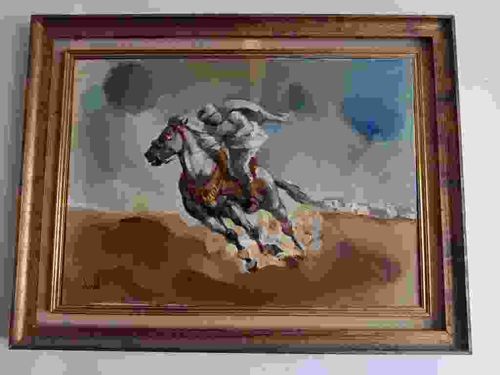
Orientalist Style Painting of a Bedouin Rider on Horseback

Fine Art - Painting

AI Estimated Value

·Not an official valuation·Verify before acting

$400 - $700

As of June 18, 2026

AI Item Analysis

·AI can make mistakes·Verify before acting
This artwork is a figurative oil painting on canvas, presented in a large, decorative wooden frame with a secondary inner frame or 'liner'. The composition depicts a dynamic scene of a Bedouin or Arab horseman riding a grey stallion at full gallop across a desert landscape. The rider is clad in flowing traditional white robes and a headpiece, suggesting an Orientalist influence. The horse features ornate red and yellow tack, including a decorated chest strap. The artist has used a palette of earthy browns for the ground, contrasting with a hazy grey and blue background that suggests distant structures or dust. The brushwork appears energetic, particularly in the rendering of the kick-up of sand and the horse's musculature. The outer frame is a classic cove-profile design with a metallic gold finish and reddish-brown distressing, consistent with mid-to-late 20th-century framing styles. A signature is visible in the lower-left corner (appears to read 'SAID' or similar), though further research would be required to identify the specific artist. The overall condition appears stable, with no immediate signs of flaking or tears, though there is a slight darkening of the varnish layer and minor nicks to the frame's edges indicative of age and handling. This piece displays a mid-level of craftsmanship aimed at the decorative art market, likely dating from the 1960s to 1980s.


AI Appraisal Report

·AI can make mistakes·Verify before acting
Upon visual examination of this Orientalist-style oil on canvas, I have identified it as a mid-to-late 20th-century decorative work, likely produced between 1960 and 1980. The painting depicts a Bedouin rider in a dynamic gallop, utilizing a palette and subject matter popularized by 19th-century masters, though executed here with the broader, more rapid brushstrokes characteristic of the commercial art market of the post-war era. The signature 'SAID' suggests a prolific artist of the period or a studio pseudonym common in pieces intended for furniture showrooms or interior design galleries. The condition appears stable; however, a slight yellowing of the varnish layer suggests the piece would benefit from a light cleaning. The frame is a period-appropriate gold-leafed cove molding which adds significant decorative presence but shows minor edge wear. The market for mid-century Orientalist decorative art remains steady for buyers seeking interior accents, though it lacks the high-value volatility of 'Fine Art' masterpieces. Comparables for unsigned or pseudonym-signed works of this scale and quality typically achieve several hundred dollars at regional auctions. The value is driven primarily by the subject's perennial appeal and the large, decorative framing rather than artist pedigree. Limitations: This appraisal is based on photographic evidence only. To fully authenticate the age and origin, an in-person inspection of the canvas weave and stretcher bar construction is required. Scientific testing such as UV fluorescence analysis would be necessary to identify any hidden repairs or overpainting, and provenance documentation (original sales receipts or gallery records) would be needed to elevate the work's status from decorative to investment-grade fine art.

Get your items appraised

Instant estimates of your treasures with AI-powered appraisals

Browse More Appraisals