These notes were written by the person who submitted this item. Appraiser.AI has not verified them, and the AI's identification and estimate may rely on them.
AI Estimated Value
Not an official valuation
$400-700
AI estimate as of July 17, 2025 · verify with a professional before acting
AI-Generated · Verify before acting
Everything on this page is generated by AI for informational purposes only. AI can make mistakes — the AI may misidentify items or misattribute them (artist, maker, brand, designer, origin, era). This is not an official valuation and should not be used for insurance, sale, tax, estate, legal, or lending purposes — or any decision requiring a certified appraisal. It is not an authoritative claim about any person, brand, or rights holder — do not share or rely on it as a factual statement about a third party. Always consult qualified professionals before making financial decisions.
This analysis also relies on unverified notes provided by the user, which may be incomplete or inaccurate and could affect the result.
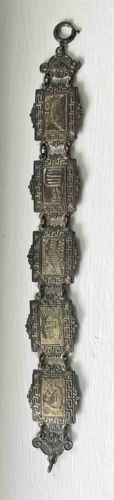
This item is identified as a Greek bracelet, likely crafted from silver or a silver-toned metal, given its dark patina and commonality of such materials in antique Greek jewelry. It features a linked construction, comprising six rectangular panels connected by small, looped rings. Each panel is rectangular with rounded corners and prominently displays a raised, central pictorial element, appearing to be historical or mythological figures in classical poses. Surrounding these central images, all panels are framed by an intricately detailed Greek key pattern, also known as a meander border, which is a hallmark of Greek design. The metal exhibits significant dark tarnishing and a noticeable patina, suggesting considerable age and the absence of recent cleaning, contributing to its antique appearance. No discernible maker's marks or signatures are visible in the provided images, but the consistent design and craftsmanship suggest a single origin. The top of the bracelet terminates in a circular jump ring for attachment, while the bottom section features a more elaborate, decorative element with scrolled motifs and a small, perhaps incomplete, hanging component, possibly where a clasp or additional charm would have been. The overall quality of the craftsmanship appears excellent, with clear details in the relief work on the panels and precise execution of the Greek key pattern, indicating skilled artistry. The visible wear, particularly the dark patina, is consistent with an older piece that has seen use over time but appears structurally sound.
AI Appraisal Report
I have examined the provided images of this Antique Greek Key Design Panel Bracelet with Figurative Reliefs. Visually, the bracelet appears consistent with an antique piece, likely from the late 19th or early 20th century, drawing inspiration from classical Greek motifs rather than being an archaeological artifact. The distinct Greek key (meander) pattern framing the panels with mythological or historical figures is a classic design element. The heavy dark patina and tarnish suggest significant age and lack of recent cleaning, contributing to its antique appearance.
Authenticity: Based on images alone, I cannot definitively confirm its age or material composition (e.g., silver content vs. base metal with silver plating). The craftsmanship appears excellent, indicating a skilled artisan. However, without in-person examination, including tactile assessment of weight and feel, and detailed inspection for maker's marks, I can only assess its visual characteristics. Full authentication would require metallurgical testing to confirm the metal composition, and ideally, provenance documentation detailing its origin and history. Without these, it's difficult to distinguish a genuine antiquity from a highly skilled historical revival piece.
Market Conditions and Comparables: The market for classical revival jewelry is stable, with demand for well-preserved, finely detailed pieces remaining consistent. Similar bracelets, identified as 'Neo-Grecian' or 'Classical Revival' from the Victorian or Art Nouveau periods, often appear in auction houses and antique jewelry dealerships. Pieces crafted from sterling silver with good detail can fetch reasonable prices.
Demand and Rarity: Items featuring clear, intricate mythological or figurative relief work combined with a strong design motif like the Greek key are desirable. While not exceedingly rare, a piece in good structural condition with historical appeal holds collector interest.
Factors Impacting Value: The excellent relief detail and craftsmanship are significant positive factors. The current heavy tarnish, while indicating age, could be a deterrent for some buyers who prefer polished pieces, but it also suggests originality. The absence of a complete clasp and visible maker's marks are minor detractions. The most significant limitation is the inability to confirm material and exact age without physical inspection and potential testing.
Conclusion: As an expert appraiser examining this item via provided images, I assess its value primarily as a beautiful and well-crafted 'Classical Revival' or 'Neo-Grecian' bracelet. Its appeal lies in its design and apparent age. For a definitive appraisal, an in-person examination would be crucial to determine metal purity, confirm construction details, and identify any hidden marks. Without this, I must base my appraisal on visual assessment and market comparables for similar items attributed to the late 19th/early 20th century revival period.