AI estimate as of October 2, 2025 · verify with a professional before acting
AI-Generated · Verify before acting
Everything on this page is generated by AI for informational purposes only. AI can make mistakes — the AI may misidentify items or misattribute them (artist, maker, brand, designer, origin, era). This is not an official valuation and should not be used for insurance, sale, tax, estate, legal, or lending purposes — or any decision requiring a certified appraisal. It is not an authoritative claim about any person, brand, or rights holder — do not share or rely on it as a factual statement about a third party. Always consult qualified professionals before making financial decisions.
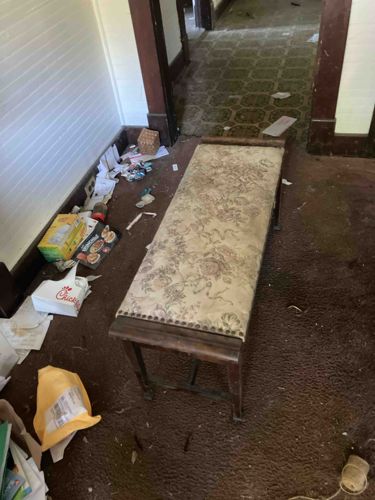
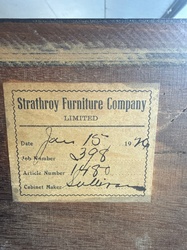
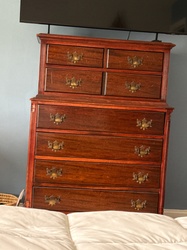
This item is an upholstered wooden bench, likely designed for seating in an entryway, hallway, or at the foot of a bed. Its overall form is rectangular, featuring a dark stained wooden frame and a padded, upholstered top. The upholstery fabric displays a floral and possibly avian pattern in muted tones of cream, beige, or light brown as the background, with the design elements rendered in darker shades, including brown, burgundy, and green accents. The edges of the upholstered top are adorned with a row of decorative brass or brass-toned nailheads, indicating a traditional method of securing the fabric and adding an aesthetic detail. The wooden frame appears to be constructed with simple, straight legs and possibly a rudimentary stretcher or crossbar connecting them for stability, though the lower part of the frame is obscured by shadow and debris. The wood has a dark, possibly mahogany or walnut, finish, consistent with furniture from an early to mid-20th-century period, though without closer inspection of joinery and wood type, this is an estimation. The condition of the bench shows visible signs of wear and tear; the upholstery fabric appears discolored, possibly stained or dirty, and may exhibit fading. The nailheads are present, but their individual condition is not clearly discernible. The wooden frame may have scratches, dings, or finish loss consistent with age and use. There are no clear manufacturer's marks or signatures visible from the provided image. The style suggests a traditional or antique aesthetic, possibly a revival style from the early to mid-20th century. The sturdy, no-frills construction points to a functional piece of furniture that prioritized utility and classic design.
AI Appraisal Report
Based on my visual examination of the provided image, this upholstered wooden bench presents as a functional piece of furniture with a traditional aesthetic. The overall form is rectangular, featuring a dark-stained wooden frame and an upholstered top with a floral/avian pattern. The finish of the wood, likely mahogany or walnut, and the style suggest an early to mid-20th-century origin, possibly a revival piece. The brass or brass-toned nailhead trim is a classic detail from this period.
The condition is a significant factor in my assessment. The upholstery fabric appears heavily discolored, possibly stained or dirty, and likely faded. This level of wear typically necessitates re-upholstery, which is a considerable expense. While the wooden frame seems structurally sound with simple, straight legs, it likely bears scratches, dings, or finish loss consistent with age and use, though these details are somewhat obscured by lighting and debris in the image. I cannot discern specific joinery or wood type from the photograph, which would provide more precise dating.
Market conditions for such pieces are modest. While a well-preserved or recently restored antique bench can fetch a higher price, the visible wear on this item places it firmly in the 'project piece' category. Demand for this style is stable but not exceptionally high. Rarity is low; benches of this type were mass-produced. Factors significantly impacting value are primarily the poor condition of the upholstery and the general wear on the frame. There are no visible manufacturer's marks or signatures, which would typically increase value if present.
Without an in-person examination, I cannot definitively verify the wood type, construction methods (e.g., hand-cut dovetails vs. machine-cut), or the true extent of damage to the frame or fabric. Physical inspection would allow me to check for structural integrity, assess the quality of the wood and joinery, and determine the exact nature and permanence of the upholstery discoloration. Provenance documentation or scientific testing (e.g., carbon dating for the wood if truly antique) would be needed for full authentication beyond my current visual assessment. Given its current state, its value is largely as a repurposable item or one requiring significant restoration.