AI Appraisal Estimate

AI-generated estimates · not official valuations

From the user

What was submitted

Photo and notes provided by the user — not generated by AI

Submitted item photo
Submitted photo · May 23, 2026

User's notes

No additional notes provided.

AI analysis below

AI appraisal

AI analysis & estimate

AI-Generated · Verify before acting

Everything below is generated by AI for informational purposes only. AI can make mistakes — the AI may misidentify items or misattribute them (artist, maker, brand, designer, origin, era). This is not an official valuation and should not be used for insurance, sale, tax, estate, legal, or lending purposes — or any decision requiring a certified appraisal. It is not an authoritative claim about any person, brand, or rights holder — do not share or rely on it as a factual statement about a third party. Always consult qualified professionals before making financial decisions.

Read the full disclaimer

AI Identification

·Not independently authenticated·Verify before acting

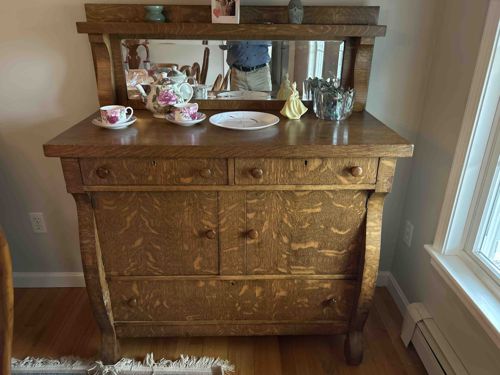
American Tiger Oak Buffet with Mirrored Backsplash

Antique Furniture

AI Estimated Value

·Not an official valuation·Verify before acting

$850 - $1,200

As of May 23, 2026

AI Item Analysis

·AI can make mistakes·Verify before acting
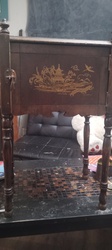
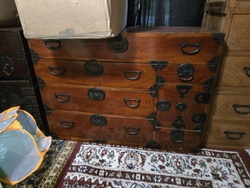
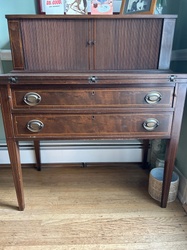
This is a late Victorian to early Edwardian era (circa 1890-1910) buffet or sideboard, crafted from high-quality quartersawn oak, commonly known as 'tiger oak' for its distinctive and dramatic medullary ray grain patterns. The piece features a rectangular top resting above two small silverware drawers over a central two-door cupboard, which sits above a single full-width lower drawer. The drawers and doors are fitted with turned wooden knobs. A significant feature is the mirrored backsplash, which includes a rectangular plate-glass mirror topped by a functional display shelf supported by scrolled brackets. The design incorporates elegant S-scroll or 'Empire' style front stiles that transition into sturdy block feet. The construction utilizes traditional joinery, evidenced by the flush fit of the drawers. The wood possesses a medium golden oak finish that highlights the intense figuring of the tiger oak veneer on the drawer fronts and doors. In terms of condition, the piece appears well-maintained with a consistent patina, though minor age-appropriate scuffs and finish wear are present near the base and edges. The mirror shows good clarity with minimal desilvering visible from this distance. There is a small keyhole on the lower drawer and upper right drawer, suggesting it originally came with a skeleton key. This style of furniture was immensely popular in Middle-American homes at the turn of the century for its durability and bold, expressive woodwork.
AI Appraisal Report

·AI can make mistakes·Verify before acting
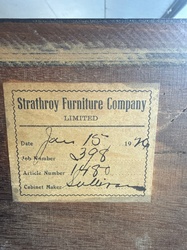
Based on my visual examination of the provided documentation, this buffet is an exemplary specimen of American Golden Oak furniture from the turn of the 20th century. The piece exhibits the high-quality quartersawn 'tiger oak' figuring that was the hallmark of the period's craftsmanship. The Empire-style S-scroll stiles and original mirrored backsplash with display shelf are particularly desirable features for collectors of this era. The condition appears structurally sound with a well-preserved original finish; the presence of original wooden knobs and keyholes suggests high historical integrity. The market for tiger oak remains steady, particularly for functional pieces like sideboards that fit well in modern dining rooms. Comparables in similar condition sold at regional antique auctions typically fall within the $800 to $1,300 range, depending on the vibrancy of the grain and the clarity of the mirror. The lack of extensive desilvering and the flush fit of the joinery support a valuation at the higher end of the mid-market spectrum. However, there are limitations to an image-based assessment. While the grain indicates authentic period veneer, a physical inspection is required to confirm the presence of hand-cut or early machine-cut dovetails and to verify that the secondary woods (drawer bottoms and backboards) are age-appropriate. Scientific testing of the finish or hardware alloy composition is rarely necessary for this style, but provenance documentation or original manufacturer stamps (often found on the rear panel) would significantly bolster the appraisal. This valuation assumes no major structural repairs or modern replacements have been made to the mirror plate or the structural frame.

Get your items appraised

Instant estimates of your treasures with AI-powered appraisals

Browse More Appraisals