AI estimate as of November 11, 2025 · verify with a professional before acting
AI-Generated · Verify before acting
Everything on this page is generated by AI for informational purposes only. AI can make mistakes — the AI may misidentify items or misattribute them (artist, maker, brand, designer, origin, era). This is not an official valuation and should not be used for insurance, sale, tax, estate, legal, or lending purposes — or any decision requiring a certified appraisal. It is not an authoritative claim about any person, brand, or rights holder — do not share or rely on it as a factual statement about a third party. Always consult qualified professionals before making financial decisions.
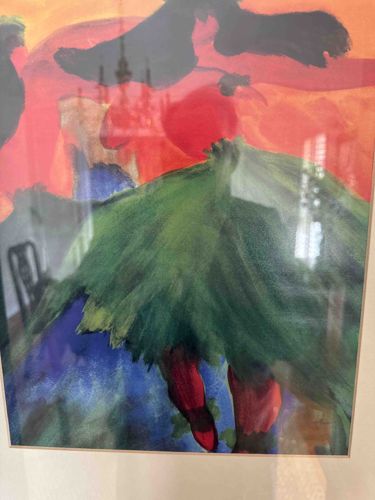
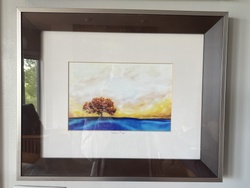
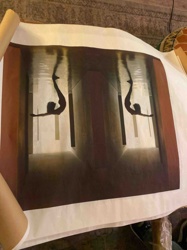
This item is an abstract expressionist watercolor painting, characterized by its vibrant color palette and fluid, gestural brushstrokes. The artwork features a dynamic composition dominated by warm hues of orange and red in the upper portion, suggesting a fiery sunset or an intense atmospheric effect. Below this, a large mass of rich green, possibly representing foliage or a landscape element, provides a strong contrast. Hints of deep blue and purple are visible beneath the green, adding depth and shadow to the composition. The brushwork appears loose and energetic, typical of abstract expressionism, with colors often bleeding into one another, creating soft transitions and blurred edges. There are dark, almost silhouetted shapes in the upper part of the painting, adding an element of mystery or suggesting distant forms. Two distinct red, somewhat abstract shapes, which could be interpreted as figures or elements within the landscape, are present in the lower right, partially obscured by the green mass. The painting appears to be framed under glass, as evidenced by reflections, though the frame itself is only partially visible along the edges. The overall condition seems good, with no obvious signs of significant damage such as tears, creases, or major discoloration. The medium is likely watercolor or a similar water-based paint due to the transparency and blending of colors. The style suggests a 20th-century origin, likely mid to late 20th century, consistent with the abstract expressionist movement. The lack of discernible signatures or clear manufacturing marks prevents a precise attribution, but the quality of the color application and compositional balance indicates a skilled hand.
AI Appraisal Report
Upon examining the provided images, this abstract expressionist watercolor painting presents as a high-quality work by a skilled, albeit unidentified, artist. The piece displays a confident command of the medium, with fluid, gestural brushwork and a sophisticated, balanced color palette. The composition is dynamic, featuring a compelling interplay between warm and cool tones. Based on the visual evidence, the painting appears to be in good condition, housed under glass, with no apparent signs of significant damage such as tears, fading, or foxing. Its style is consistent with mid-to-late 20th-century abstract expressionism.
The primary factor limiting the value is the lack of attribution. Unsigned works, while aesthetically pleasing, are challenging to position in the market. Current market conditions for decorative, high-quality, anonymous 20th-century abstract art are steady. Comparable works by unknown but skilled artists from this period typically sell in the low to mid-hundreds at auction or in galleries. The larger size and strong visual appeal of this piece place it at the higher end of that range.
It is crucial to note the limitations of this appraisal, as it is based solely on images. A definitive assessment of condition and authenticity is not possible. For full authentication, an in-person examination is required to inspect the paper stock for watermarks, assess the paint application under magnification, and examine the artwork out of its frame. Establishing provenance through receipts or exhibition history would significantly increase its value. If a signature were discovered upon physical inspection, its value could change dramatically depending on the artist.