AI estimate as of July 12, 2025 · verify with a professional before acting
AI-Generated · Verify before acting
Everything on this page is generated by AI for informational purposes only. AI can make mistakes — the AI may misidentify items or misattribute them (artist, maker, brand, designer, origin, era). This is not an official valuation and should not be used for insurance, sale, tax, estate, legal, or lending purposes — or any decision requiring a certified appraisal. It is not an authoritative claim about any person, brand, or rights holder — do not share or rely on it as a factual statement about a third party. Always consult qualified professionals before making financial decisions.
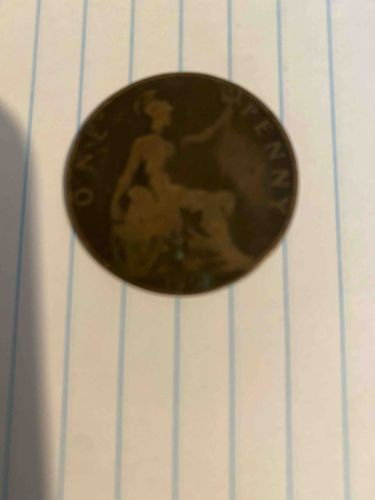
The item is a circular metal coin, appearing to be made of bronze or copper due to its prominent reddish-brown coloration and visible patina. The obverse side is partially visible, showing what appears to be a seated female figure, likely Britannia, facing right. She is depicted holding a trident in her left hand and potentially a shield with the Union Flag visible on it, although the entire design is not clear. Around the upper edge of the coin, the words "ONE PENNY" are clearly legible, with "ONE" on the left side and "PENNY" on the right. The lower part of the coin, which would typically contain the date, is obscured or too worn to be read precisely. There are signs of significant wear on the surface, evidenced by general dimming of details and loss of luster, consistent with a circulated coin. The overall condition suggests a vintage or antique piece, given the heavy dark brown and green patina in areas, indicating prolonged exposure and oxidation. Despite the wear, the key identifying features like the denomination and the iconic Britannia figure are discernible, suggesting a British pre-decimal penny. The craftsmanship appears to be typical of mass-produced coinage of its era, with good detail retention in areas that are not heavily worn. The lack of clear date or monarch's effigy prevents a precise dating, but the design is consistent with various issues of UK pennies from the late 19th to mid-20th centuries.
AI Appraisal Report
Based on my visual examination of the provided image, this appears to be a British One Penny coin featuring the Britannia reverse. The prominent reddish-brown coloration and clear patina are consistent with bronze or copper issues, typical for this denomination. The obverse clearly shows the 'ONE PENNY' inscription and the iconic seated Britannia figure with trident and shield, confirming its identity as a pre-decimal British penny.
Condition: The coin exhibits significant wear, evidenced by the general dimming of details, loss of luster, and heavy dark brown and green patina. The lack of a clear date or discernible monarch’s effigy due to wear or obscuration is a significant limiting factor. The overall condition places it in a 'Good' (G) to 'Very Good' (VG) circulated grade due to the clear legibility of the main design elements despite considerable wear.
Authenticity and Limitations: From the image, the coin appears authentic in its design and material characteristics. However, full authentication without physical examination is impossible. I cannot definitively verify its precise alloy composition, weight, or detect potential alterations or clever counterfeits that mimic wear. A physical inspection would allow for measurement, weight verification, and closer examination of strike details and edge, crucial for definitive authenticity and grading. Provenance documentation, if available, would also add to its verifiable history.
Market Conditions and Value Factors: British One Penny coins, especially common dates in circulated condition, are widely available. Their value is heavily influenced by their date, mint mark, and condition. Rarity typically applies to specific key dates or exceptionally high-grade examples. This coin, lacking a discernible date and being in a heavily circulated state, sits at the lower end of the value spectrum for these issues. Demand for common date, heavily worn pennies is generally low among serious collectors, though they hold some appeal as historical curiosities or entry-level collectibles.
Comparables for similar heavily circulated, undated British Pennies typically fetch very modest sums.
In-person examination would be needed to potentially discern a faint date, assess subtle details, and confirm the coin's precise attributes, which could, in rare cases, reveal a more valuable key date.