These notes were written by the person who submitted this item. Appraiser.AI has not verified them, and the AI's identification and estimate may rely on them.
AI Estimated Value
Not an official valuation
$1,500-2,500
AI estimate as of December 16, 2025 · verify with a professional before acting
AI-Generated · Verify before acting
Everything on this page is generated by AI for informational purposes only. AI can make mistakes — the AI may misidentify items or misattribute them (artist, maker, brand, designer, origin, era). This is not an official valuation and should not be used for insurance, sale, tax, estate, legal, or lending purposes — or any decision requiring a certified appraisal. It is not an authoritative claim about any person, brand, or rights holder — do not share or rely on it as a factual statement about a third party. Always consult qualified professionals before making financial decisions.
This analysis also relies on unverified notes provided by the user, which may be incomplete or inaccurate and could affect the result.
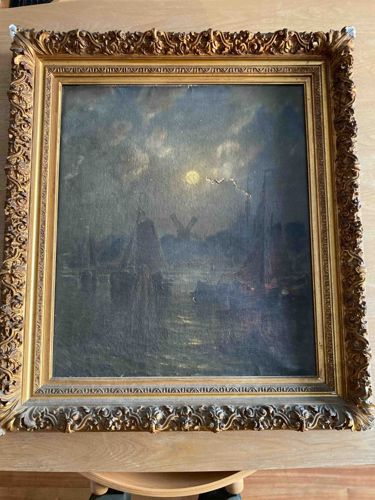
This item is an antique oil painting depicting a nocturne seascape scene under a full moon. The painting, likely executed on canvas, is housed within an elaborate, gilded wooden frame. The central imagery features several sailing vessels, possibly fishing boats, navigating choppy waters under a dramatic, cloudy night sky. A prominent full moon, casting a bright, luminous glow, is visible through a break in the clouds, illuminating the water and the sails of the boats. In the distance, a windmill silhouette adds a classical Dutch or European coastal element. The color palette is dominated by dark blues, grays, and the warm yellow-white of the moonlight, creating a serene yet atmospheric scene. The brushwork appears to be somewhat loose but detailed enough to convey the movement of the water and the textures of the clouds. The painting exhibits signs of age, including a visible craquelure pattern across the surface, which is typical for older oil paintings and suggests a period piece. There are also potential areas of discoloration or darkening of the varnish layer, contributing to a muted overall appearance that often occurs with age. The frame complements the painting with rich, ornate carvings of foliage and scrolls, finished with a gold-tone gilt that shows some signs of wear and chipping, particularly at the corners and raised edges, revealing the darker substrate beneath. The inner section of the frame features a simpler, repeated geometric or stylized floral motif. The overall style suggests a 19th-century or early 20th-century European Romantic or Barbizon school influence, characteristic of marine art from that era. The craftsmanship of the frame indicates a high-quality piece, designed to enhance the artwork.
AI Appraisal Report
Based on my visual examination of the provided image, this 'Moonlight Seascape with Boats and Windmill' is a compelling piece. The visible craquelure pattern is a strong indicator of age, consistent with an oil painting from the late 19th or early 20th century, aligning with the suggested European Romantic or Barbizon school influence. The atmospheric quality, dramatic lighting, and subject matter are hallmarks of marine art from that period. The elaborate gilded frame, though showing wear and chipping, speaks to its original quality and intended presentation.
The market for 19th and early 20th-century seascapes, particularly those with evocative nocturnal scenes, remains steady. Comparable unsigned or unattributed works of this subject and condition generally fall within the $1,000-$3,000 range, depending on the subtlety of execution and overall artistic merit. This painting exhibits good compositional balance and skillful rendering of light, which enhances its appeal. The demand for well-preserved period pieces such as this, even if by an unknown artist, ensures a modest but consistent market.
Factors impacting value include the visible discoloration of the varnish layer, which can mute the original color vibrancy; however, this is often reversible with professional conservation. The frame's wear is also a factor, though minor. For a definitive authentication, an in-person examination would be crucial to assess the paint layers, stretcher, canvas type, and potential signatures or artist's marks under UV light. Additionally, any provenance documentation would significantly impact the value and could potentially elevate it considerably if an important artist is identified.