AI estimate as of August 15, 2025 · verify with a professional before acting
AI-Generated · Verify before acting
Everything on this page is generated by AI for informational purposes only. AI can make mistakes — the AI may misidentify items or misattribute them (artist, maker, brand, designer, origin, era). This is not an official valuation and should not be used for insurance, sale, tax, estate, legal, or lending purposes — or any decision requiring a certified appraisal. It is not an authoritative claim about any person, brand, or rights holder — do not share or rely on it as a factual statement about a third party. Always consult qualified professionals before making financial decisions.
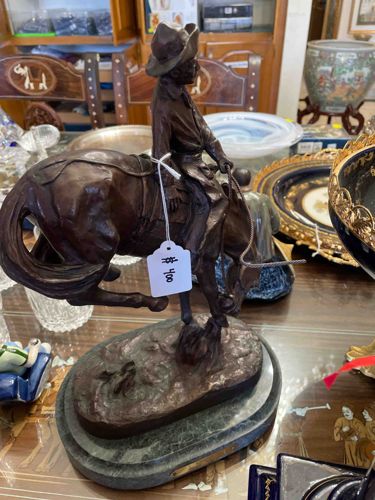
The item is a bronze sculpture depicting a cowboy on horseback. The overall dimensions appear to be approximately 12-18 inches in height, mounted on a substantial base. The cowboy figure, dressed in traditional Western attire including a wide-brimmed hat, appears to be holding reins or a lariat. The horse is dynamically posed, suggesting movement, possibly a trot or canter, with one front leg raised. The sculpture exhibits a deep, rich brown patina, typical of aged bronze, with some lighter areas on raised surfaces hinting at natural wear or highlights from handling. The craftsmanship suggests a lost-wax casting method, given the intricate details of the figures and the rough, textured appearance of the ground base. The base itself is comprised of two distinct parts: an irregular, rocky-textured bronze section seamlessly integrated with the horse's hooves, and beneath that, a polished, variegated green marble plinth. The marble base shows natural veining characteristic of the stone. There are no immediately obvious significant condition issues such as cracks or major repairs, although the patina's slight inconsistencies might indicate minor abrasions over time. A small white pricing tag is tied to the horse's flank, obscuring some detail in that area. The style points to a Western art genre, likely from the mid-to-late 20th century. The quality of detail in the musculature of the horse and the attire of the cowboy suggests a skilled sculptor.
AI Appraisal Report
Upon visual examination of this bronze sculpture, I can provide an estimated appraisal. The piece depicts a cowboy on horseback, exhibiting dynamic movement and intricate detailing characteristic of the lost-wax casting method. The rich brown patina appears consistent with aged bronze, and the combination of the textured bronze base with a polished green marble plinth enhances its aesthetic appeal. From the image, the condition appears good, with no obvious major damage, cracks, or repairs. Minor inconsistencies in the patina suggest typical wear or handling over time.
Authenticity, based solely on visual inspection of an image, is challenging. While the craftsmanship suggests a skilled hand, definitive authentication would require an in-person examination to assess the quality of the bronze, the precision of the casting, and to look for artist signatures, foundry marks, or edition numbers. Provenance documentation, such as original sales receipts or certificates of authenticity, would be crucial. Scientific testing, like elemental analysis of the bronze, could also confirm the period of creation. The small white tag on the horse's flank obscures some detail and should be removed for a full assessment.
In terms of market conditions, Western-themed bronze sculptures generally maintain consistent demand, especially those with good detail and dynamic composition. Comparables in this size and quality range, particularly from known artists, can vary widely. However, without a signature or definitive provenance, the piece is currently valued as "decorative arts" rather than a named artist's work, which significantly impacts its top-end value. Demand is steady for such pieces in Western art markets, but rarity cannot be determined without knowing the artist and edition size. The lack of a visible signature or provenance documentation is a primary limiting factor for a higher valuation.
Factors impacting value include the quality of the casting and patina, the appealing subject matter, and the presence of a substantial marble base. The primary factor limiting a higher appraisal is the absence of an identifiable artist, provenance, or edition information.