These notes were written by the person who submitted this item. Appraiser.AI has not verified them, and the AI's identification and estimate may rely on them.
AI Estimated Value
Not an official valuation
$75-125
AI estimate as of November 22, 2025 · verify with a professional before acting
AI-Generated · Verify before acting
Everything on this page is generated by AI for informational purposes only. AI can make mistakes — the AI may misidentify items or misattribute them (artist, maker, brand, designer, origin, era). This is not an official valuation and should not be used for insurance, sale, tax, estate, legal, or lending purposes — or any decision requiring a certified appraisal. It is not an authoritative claim about any person, brand, or rights holder — do not share or rely on it as a factual statement about a third party. Always consult qualified professionals before making financial decisions.
This analysis also relies on unverified notes provided by the user, which may be incomplete or inaccurate and could affect the result.
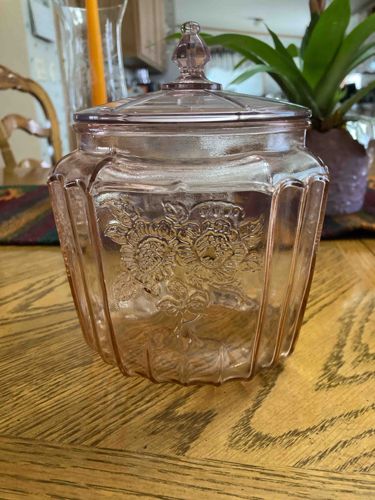
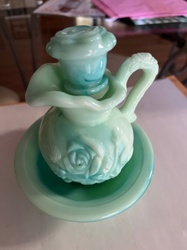
This is a vintage pink Depression Glass cookie jar, characterized by its rosy hue and pressed glass construction. The jar is octagonal in shape with prominent vertical ribbing along each facet, creating a multifaceted appearance. The most striking feature is the detailed floral relief pattern on three of its visible sides, depicting what appear to be sunflowers or similar large, intricate blossoms with associated foliage. The design is raised, giving it a tactile quality. The lid is also made of the same pink glass and features a matching octagonal shape with radial lines pressed into its surface, culminating in a decorative finial at the center. The finial is a stacked, tear-drop or inverted pear shape, adding to the jar's elegant silhouette. The overall condition appears good with no immediately visible chips, cracks, or significant damage from the provided images, though a full inspection would be required to confirm this. The glass has a characteristic translucent quality, common in Depression Glass, which allows light to pass through and highlight its delicate color. The bottom edge of the jar also features a scalloped or gently curved relief that matches the faceting. Given the style and materials, this piece likely dates to the early to mid-20th century, specifically the 1920s-1940s, a period known for mass-produced colored pressed glass. There are no visible maker's marks in the provided images, but the pattern suggests a specific manufacturer from that era. Its craftsmanship is typical of the period, demonstrating functional yet decorative qualities.
AI Appraisal Report
Upon visual examination of the provided image, this pink Depression Glass cookie jar presents as an authentic piece from the 1920s-1940s period, consistent with the description of its rosy hue, octagonal shape, vertical ribbing, and detailed floral relief. The translucent quality of the glass and the pressing methods are typical of glassware produced during the Depression Era. The lid, with its matching octagonal shape, radial lines, and decorative tear-drop finial, further supports its period authenticity. From the image, the condition appears good; there are no immediately visible chips, cracks, or significant damage, which positively impacts its value. However, a full, in-person inspection would be crucial to confirm the absence of minor flea bites, internal stress cracks, or repairs that are not detectable from photographs. The lack of visible maker's marks is common for Depression glass, though identification of the specific pattern could lead to manufacturer attribution.
Market conditions for Depression Era glassware remain steady, with collector interest varying by pattern, color, and rarity. While pink is a desirable color, cookie jars are generally less common than other tableware items, adding a slight premium. Comparables for similar pink Depression glass cookie jars in good condition typically fall within the $75-$150 range, depending on pattern desirability and manufacturer. This particular floral relief pattern appears well-defined, suggesting a quality pressing. Demand for well-preserved examples remains consistent among collectors. Limitations in authenticity verification from images alone include the inability to fully assess internal defects, verify the integrity of the lid's seating, or check for subtle alterations. A physical examination would allow for tactile inspection, detailed lighting analysis for flaws, and potential identification of faint maker's marks or pattern recognition through specialized resources for full authentication.