AI estimate as of July 16, 2025 · verify with a professional before acting
AI-Generated · Verify before acting
Everything on this page is generated by AI for informational purposes only. AI can make mistakes — the AI may misidentify items or misattribute them (artist, maker, brand, designer, origin, era). This is not an official valuation and should not be used for insurance, sale, tax, estate, legal, or lending purposes — or any decision requiring a certified appraisal. It is not an authoritative claim about any person, brand, or rights holder — do not share or rely on it as a factual statement about a third party. Always consult qualified professionals before making financial decisions.
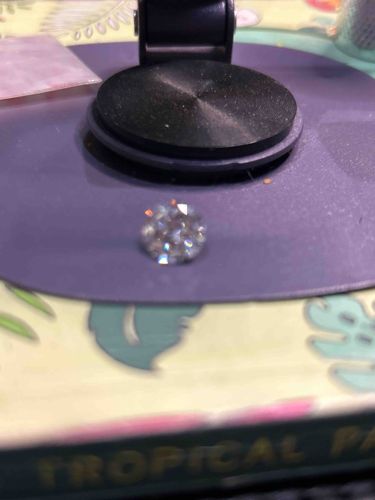
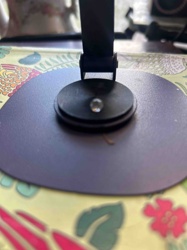
The item appears to be a single, colorless, brilliant-cut gemstone, likely a diamond or a diamond simulant. It is relatively small in size, resting directly on a purple mat or surface, with a black circular object (possibly a stand or a tool component) in the background. The stone exhibits significant sparkle and fire, indicative of its multi-faceted construction designed to maximize light reflection and dispersion. The facets are clearly visible, creating numerous bright areas and reflections, suggesting a well-cut stone. Its circular shape indicates a round brilliant cut, which is one of the most popular and traditional cuts for diamonds, known for its optimal light performance. The color appears to be in the colorless to near-colorless range, without any discernible yellow or brown tints under the ambient lighting. No visible inclusions or blemishes are apparent from this image, though a closer inspection with magnification would be required to determine clarity. There are no apparent chips, cracks, or significant wear on the stone itself, suggesting it is either newly cut or well-preserved. There are no visible maker's marks, signatures, or stamps directly on the stone, as these are typically not present on loose gemstones. Given the clarity and brilliance, it indicates a gem of at least good quality. Without further information or specialized tools, it is impossible to definitively determine if it is a natural diamond, a lab-grown diamond, or a simulant like cubic zirconia or moissanite. Its estimated age cannot be determined from the visual information alone.
AI Appraisal Report
Based on my visual examination of the provided image, this appears to be a well-cut, colorless round brilliant gemstone. The facets are clearly defined, exhibiting significant brilliance and fire, indicative of excellent light performance. Its circular shape and numerous facets align with the characteristics of a round brilliant cut, which is highly sought after for its sparkle. The stone appears to be in excellent condition, with no visible chips, cracks, or significant abrasions. I observe no discernible color tint, placing it in the colorless to near-colorless range, which enhances its aesthetic appeal and value. From the visual evidence, no inclusions or blemishes are apparent, suggesting a clarity grade of at least 'eye-clean'.
However, a crucial limitation of image-based appraisal is the inability to definitively confirm authenticity and precise characteristics. While it exhibits desirable visual properties of a diamond, I cannot ascertain whether it is a natural diamond, a lab-grown diamond, or a simulant such as cubic zirconia or moissanite without physical inspection. The market values for these vastly differ; natural diamonds command the highest prices, followed by lab-grown diamonds, with simulants being significantly less valuable.
Factors significantly impacting value, apart from authenticity, include carat weight (which cannot be accurately determined from an image), precise color and clarity grades (requiring specialized grading tools), and cut parameters. Given its apparent brilliance and colorless appearance, if this were a natural diamond of moderate size (e.g., 0.5-1.0 carat), its value could range significantly based on its exact 4Cs.
For full authentication and accurate valuation, an in-person examination is critical. This would involve using gemological tools such as a loupe or microscope for clarity assessment, a refractometer for refractive index, specific gravity tests, and potentially thermal conductivity tests or advanced spectroscopy (e.g., Raman, FTIR, UV-Vis-NIR) to differentiate between natural diamond, lab-grown diamond, and simulants. Furthermore, precise carat weight measurement and a detailed assessment of cut proportions would be required. Provenance documentation, if available, would also aid in establishing the stone's history and authenticity.