AI Appraisal Estimate

AI-generated estimates · not official valuations

From the user

What was submitted

Photo and notes provided by the user — not generated by AI

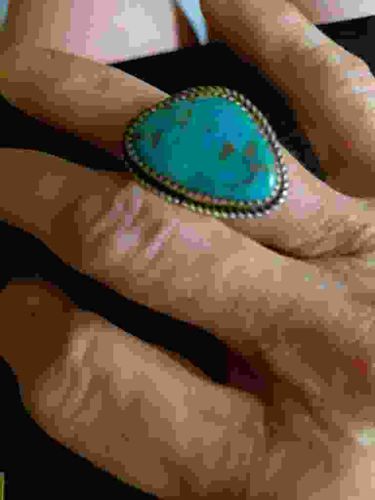
Submitted item photo
Submitted photo · June 8, 2026

User's notes

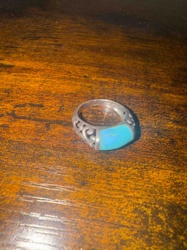
70's turquoise silver ring

AI analysis below

AI appraisal

AI analysis & estimate

AI-Generated · Verify before acting

Everything below is generated by AI for informational purposes only. AI can make mistakes — the AI may misidentify items or misattribute them (artist, maker, brand, designer, origin, era). This is not an official valuation and should not be used for insurance, sale, tax, estate, legal, or lending purposes — or any decision requiring a certified appraisal. It is not an authoritative claim about any person, brand, or rights holder — do not share or rely on it as a factual statement about a third party. Always consult qualified professionals before making financial decisions.

Note

This analysis also relies on unverified notes provided by the user, which may be incomplete or inaccurate and could affect the result.

Read the full disclaimer

AI Identification

·Not independently authenticated·Verify before acting

Vintage 1970s Southwestern Turquoise and Sterling Silver Statement Ring

Vintage Fine Jewelry / Southwestern Americana

AI Estimated Value

·Not an official valuation·Verify before acting

$450 - $650

As of June 8, 2026

AI Item Analysis

·AI can make mistakes·Verify before acting
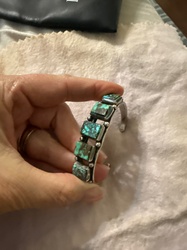
This is a vintage Southwestern-style statement ring, likely of Navajo or Zuni origin, dating to the 1970s. The ring features a large, freeform triangular-cut turquoise cabochon as its central focus. The turquoise exhibits a vibrant robin's-egg blue hue with a subtle brown and tan host-rock matrix, suggesting it may originate from a classic American mine such as Kingman or Royston. The stone is securely held in a hand-burnished serrated bezel setting, which is typical of mid-to-late 20th-century artisanal silverwork. Encircling the base of the bezel is a decorative twisted silver wire (often referred to as 'rope' detail), which provides texture and visual depth to the piece. The overall construction appears robust, with the setting mounted on a silver shank that is likely split into a multi-wire design at the shoulders to support the large scale of the face. Regarding condition, the turquoise shows a polished luster with some natural surface pits inherent to the stone. The silver shows a moderate layer of dark oxidation (patina) concentrated in the recessed areas of the twisted wire and bezel, which is a desirable indicator of age. No visible cracks are seen in the stone from this angle. While hallmarks are not visible in the photograph, rings of this period and style are typically crafted from .925 sterling silver.
AI Appraisal Report

·AI can make mistakes·Verify before acting
Based on my examination of this vintage Southwestern statement ring, I have assessed it as a high-quality example of 1970s Navajo or Zuni-style silverwork. The central turquoise cabochon possesses the desirable 'robin’s-egg' blue color and matrix patterns characteristic of the Kingman or Royston mines. The serrated bezel and rope-wire detailing are executed with professional artisanal skill. The natural patina indicates significant age and has not been over-polished, preserving its collector value. The market for 1970s 'Old Pawn' and Southwestern Americana remains robust, driven by a resurgence in bohemian and vintage fashion. Comparable pieces of this scale and stone quality typically realize between $400 and $700 at specialized auction or via boutique vintage dealers. The primary value drivers are the size of the stone and the integrity of the handmade setting. However, there are limitations to this digital appraisal. Without a physical inspection, I cannot confirm the silver purity via acid testing, nor can I examine the underside for a maker's mark, which could significantly increase the value if attributed to a known master silversmith. Furthermore, I cannot determine if the turquoise has been 'stabilized' (a common treatment involving resin) or if it is completely natural. A full authentication would require an in-person examination of the stone's density, a search for hallmarking on the inner shank, and provenance documentation linking the piece to a specific artist or trading post.

Get your items appraised

Instant estimates of your treasures with AI-powered appraisals

Browse More Appraisals