AI estimate as of August 16, 2025 · verify with a professional before acting
AI-Generated · Verify before acting
Everything on this page is generated by AI for informational purposes only. AI can make mistakes — the AI may misidentify items or misattribute them (artist, maker, brand, designer, origin, era). This is not an official valuation and should not be used for insurance, sale, tax, estate, legal, or lending purposes — or any decision requiring a certified appraisal. It is not an authoritative claim about any person, brand, or rights holder — do not share or rely on it as a factual statement about a third party. Always consult qualified professionals before making financial decisions.
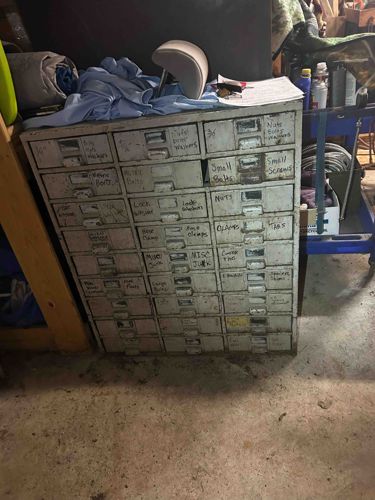
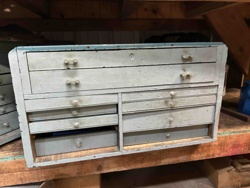
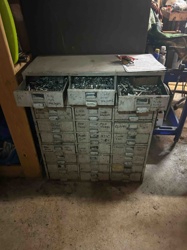
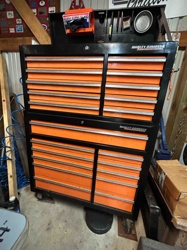
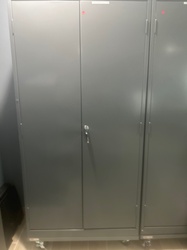
The item is a multi-drawer metal storage cabinet, commonly known as a parts bin or hardware organizer cabinet. It appears to be constructed from sheet metal, likely steel, given its sturdy appearance and the typical materials for such utilitarian pieces. The color is an off-white or light gray, showing significant wear, discoloration, and grime, indicative of prolonged use in a workshop or industrial setting. There are numerous rectangular drawers, each with a small lip or handle for pulling, and a slot for labels. Many of these slots contain handwritten labels such as "Small Bolts," "Nuts," "Clamps," "Misc Junk," "Washers," and "Screws," providing insight into its intended function. The cabinet shows considerable signs of age and use, including scratches, scuffs, areas where the original paint has flaked or worn away, and general surface dirt. The patina suggests it is an older piece, possibly mid-20th century, with a robust, industrial aesthetic. There are no visible maker's marks or distinct signatures in the provided images, but the design is typical of storage units produced by various manufacturers during that period. The construction is riveted or spot-welded, reflecting a utilitarian, durable build. Its rustic and worn condition might appeal to collectors of industrial decor or those seeking functional vintage storage.
AI Appraisal Report
I have examined the provided image of the multi-drawer metal parts bin / hardware organizer cabinet. Visually, the condition is consistent with significant age and heavy use, displaying a well-developed industrial patina characterized by extensive scuffs, scratches, paint loss, and surface grime. This 'distressed' aesthetic is often desirable in today's market for industrial decor. The handwritten labels add to its authentic, utilitarian charm and suggest a long history of practical application. Based on the construction style (riveted/spot-welded sheet metal) and general appearance, I assess its authenticity as a genuine vintage piece, likely mid-20th century.
Market conditions for vintage industrial storage are generally strong, with a consistent demand from interior designers, antique dealers specializing in industrial salvage, and individuals seeking unique, functional decor. Comparable items, such as similar multi-drawer metal cabinets from manufacturers like Lyon, Republic Steel, or even unmarked utilitarian pieces, typically sell in the range of $300-$700 depending on size, number of drawers, and specific condition.
The primary factors impacting its value positively are its authentic vintage appeal, functional utility, and the desirable 'used' aesthetic. Negatively, the extensive surface wear and dirt might deter some buyers seeking a more pristine example, though for industrial decor, this is often a plus. The lack of a visible maker's mark prevents attributing it to a specific, potentially more collectible, manufacturer, which slightly limits its upper value potential but does not significantly detract from general market appeal. Its rarity is moderate; while not unique, well-preserved examples with this many drawers are becoming less common.
Limitations: My assessment of authenticity and condition is based solely on the provided image. For full authentication, I would require an in-person examination to assess the structural integrity, confirm the metal type, inspect for any repairs or alterations that are not visible, and search for faint maker's marks, serial numbers, or other identifiers not captured in the photograph. I would also use a magnet to confirm it is ferrous metal and potentially test for lead paint if safety were a concern. Provenance documentation (e.g., original purchase receipts, historical photos) would further solidify authenticity and history, but is rarely available for such utilitarian items.