AI estimate as of September 10, 2026 · verify with a professional before acting
AI-Generated · Verify before acting
Everything on this page is generated by AI for informational purposes only. AI can make mistakes — the AI may misidentify items or misattribute them (artist, maker, brand, designer, origin, era). This is not an official valuation and should not be used for insurance, sale, tax, estate, legal, or lending purposes — or any decision requiring a certified appraisal. It is not an authoritative claim about any person, brand, or rights holder — do not share or rely on it as a factual statement about a third party. Always consult qualified professionals before making financial decisions.
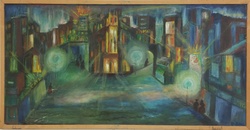
This is an oil painting on canvas showcasing a characteristic Tubist and Cubist composition, featuring heavily mechanized, cylindrical, and geometric human figures interacting within a complex, highly structured urban or industrial architectural interior. The color palette is dominated by contrasting muted grays, stark blacks, and whites, accented with bold primary and secondary tones including vibrant orange, deep blue, dark purple, and hints of red and green. The physical structure of the work employs thick, flat application of paint combined with subtle shading to give volumetric, metallic, and machine-like qualities to the figures and background elements. Notable features include a visible signature located in the lower right corner, appearing to read 'F. Lger' alongside what may be a date or monogram. Given the blue-chip nature of the referenced artist, this piece must be approached with extreme caution, as the base rate strongly favors a print, reproduction, or forgery, and the work remains completely unauthenticated from a visual photo alone. The stylistic characteristics are highly consistent with the interwar modern art period, specifically mimicking the mechanical aesthetic popularized during the early 20th century. The canvas displays normal aging including minor surface dust and subtle craquelure consistent with older painted media, but no major tears or visible repairs. The identification rests purely on the presence of the legible signature at the lower right and the distinctive mechanical-cubist style, though no claim of genuine authorship or museum attribution is asserted.
AI Appraisal Report
Based on what I can see in the provided image, this oil painting on canvas presents a characteristic Tubist and Cubist composition featuring mechanized, geometric human figures within an industrial interior. The palette utilizes muted grays, blacks, and whites accented with vibrant primary and secondary tones, while the paint application employs thick, flat strokes combined with subtle shading. The lower right corner bears a signature that reads 'F. Lger'. However, I cannot verify from a photo alone whether the work is an autograph piece by Fernand Lger or a period-appropriate reproduction, copy, or work executed in the artist's manner. A visual examination alone cannot establish authorship, as signatures and stylistic traits can be replicated. If the attribution to Fernand Lger were to be supported by physical and historical analysis, works of this scale and style from the interwar modern art period typically command substantial figures in the fine art market, falling within a broad range of $50,000 to $150,000 depending on condition, specific exhibition history, and market demand for the period. Conversely, if physical inspection reveals the piece to be a later copy, reproduction, or a work merely in the style of the artist rather than by his hand, the value would be substantially lower, likely restricted to the decorative art range of several hundred to a few thousand dollars. The canvas displays normal aging features including minor surface dust and subtle craquelure, but no major tears are visible. Would need physical inspection to confirm the medium's integrity, canvas age, and pigment composition. To move beyond this working assumption, the item would require in-person examination by a qualified fine art conservator, scientific pigment and canvas testing, and extensive research into provenance documentation to support any claim of genuine authorship.