AI estimate as of October 10, 2025 · verify with a professional before acting
AI-Generated · Verify before acting
Everything on this page is generated by AI for informational purposes only. AI can make mistakes — the AI may misidentify items or misattribute them (artist, maker, brand, designer, origin, era). This is not an official valuation and should not be used for insurance, sale, tax, estate, legal, or lending purposes — or any decision requiring a certified appraisal. It is not an authoritative claim about any person, brand, or rights holder — do not share or rely on it as a factual statement about a third party. Always consult qualified professionals before making financial decisions.
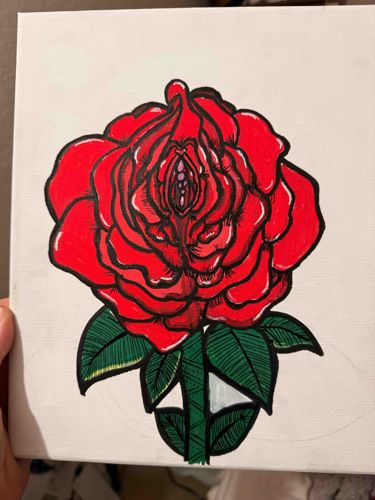
This item is a small, unframed canvas painting featuring a stylized rose, or more specifically, a unique representation that incorporates vulvar anatomy into the central bloom. The primary colors used are vibrant red for the petals and a deep green for the stem and leaves, all outlined with a distinct black line, giving it a cartoonish or graphic novel aesthetic. The painting is executed on a white stretched canvas, which appears to be a standard small size, possibly 8x10 inches or 10x10 inches, though exact dimensions are not visible. The paint application appears to be flat and opaque, suggesting the use of acrylics or markers. The most notable feature is the intricate detail at the center of the rose, depicting a labia-like structure rendered in shades of purple and pink, contributing to a strong feminist or body-positive artistic statement. There are no discernible artist signatures, dates, or marks within the visible area. The background is a clean, unpainted white, emphasizing the central image. The visible condition suggests it is recent, with no apparent wear, damage, or repairs, aside from a faint pencil line visible to the bottom right of the stem, indicating initial sketching. The edges of the canvas appear crisp. It leans towards contemporary art, likely created within the last decade, and its uniqueness lies in its bold, anatomical interpretation of a traditional floral motif. The craftsmanship is clean with well-defined lines and solid color blocks, indicating a degree of care in its execution.
AI Appraisal Report
This unframed canvas painting, featuring a stylized rose with integrated vulvar anatomy, presents as a contemporary piece with a bold, graphic aesthetic. My visual examination indicates excellent condition; there are no signs of wear, damage, or repairs, aside from a faint pencil sketch line visible near the stem, suggesting a recent creation. The flat, opaque paint application and distinct black outlines point towards acrylics or possibly paint markers. Authenticity, in terms of artist attribution, cannot be determined from images alone as there are no visible signatures or markings. The workmanship is clean with well-defined lines and solid color blocks.
The market for similar contemporary, unsigned, small-scale canvas art by emerging or unknown artists is generally modest. While its unique anatomical interpretation of a floral motif and potential feminist or body-positive statement could appeal to specific collectors, it's a niche market. The lack of an established artist, exhibition history, or provenance documentation significantly impacts its value, limiting it primarily to its decorative and artistic merit rather than investment potential. Demand would likely come from buyers seeking unique, modern art with a distinct message, or as a conversation piece. Rarity, in terms of its specific subject matter, is moderate within the broader contemporary art landscape, but its unsigned status prevents it from commanding higher prices.
For full authentication of artist and origin, an in-person examination would be crucial to inspect paint layers, canvas texture, and hidden markings. Provenance documentation, such as a bill of sale or artist's statement, would be essential for establishing authorship. Scientific testing is not typically warranted for pieces of this nature unless questions of material authenticity arise.