AI estimate as of August 9, 2025 · verify with a professional before acting
AI-Generated · Verify before acting
Everything on this page is generated by AI for informational purposes only. AI can make mistakes — the AI may misidentify items or misattribute them (artist, maker, brand, designer, origin, era). This is not an official valuation and should not be used for insurance, sale, tax, estate, legal, or lending purposes — or any decision requiring a certified appraisal. It is not an authoritative claim about any person, brand, or rights holder — do not share or rely on it as a factual statement about a third party. Always consult qualified professionals before making financial decisions.
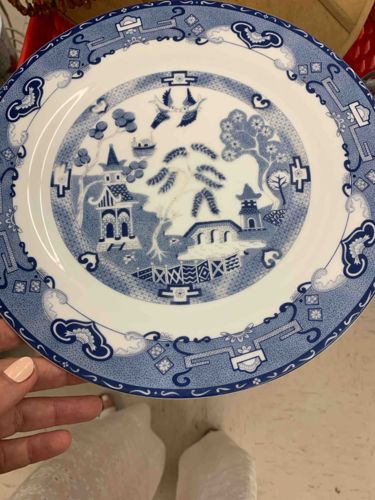
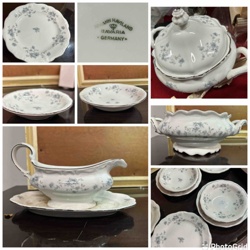
This is a ceramic dinner plate, likely made of porcelain or ironstone, featuring the classic blue and white 'Willow Pattern' design. The plate appears to be of standard dinner plate size, round with a slightly raised rim. The dominant colors are a rich cobalt blue on a pristine white background. The central design depicts a traditional Chinese landscape, including pagodas, a bridge with three figures, a willow tree, other foliage, and two birds in flight at the top. The border of the plate is adorned with a more abstract, geometric and floral pattern, also in blue, which contrasts with the narrative scene in the center. A distinctive element within the border are the 'cracked ice' or cloud-like motifs interspersed with squared elements. The craftsmanship appears to be of good quality, with clear, crisp lines in the transferware pattern. There are no immediately visible chips, cracks, or significant wear, suggesting it is either well-preserved or a relatively recent production. The glaze seems intact and glossy, indicating good condition. Without a view of the back, specific maker's marks, country of origin, or precise age cannot be determined, but the Willow Pattern has been produced by numerous manufacturers globally since the late 18th century, making it difficult to pinpoint without further information. The plate's design is typical of late 18th to present-day transferware produced in England, America, and Asia.
AI Appraisal Report
Upon visual examination of this blue and white dinner plate, I can identify it as a classic example of the 'Willow Pattern,' one of the most enduring designs in transferware history. The condition appears to be excellent, with a glossy, intact glaze and no visible chips, cracks, or discoloration. The cobalt blue transfer is crisp and well-defined, suggesting good quality craftsmanship, though it could be from a wide range of production dates, from the 19th century to modern times.
The market for individual Willow Pattern plates is generally stable but vast. The item's value is highly dependent on its age, manufacturer, and rarity. Without a maker's mark, which would be on the reverse, its origin is impossible to confirm from the image alone. An early piece from a renowned English pottery like Spode or Wedgwood would be significantly more valuable than a 20th-century or more recent mass-produced example from Asia or America. The primary factor limiting this appraisal is the lack of a reverse view.
For a full authentication, a physical, in-person examination is crucial. I would need to inspect the back of the plate for any impressed or printed maker's marks, examine the feel of the ceramic body (e.g., porcelain vs. ironstone), and look for signs of age-appropriate wear under magnification, such as subtle utensil marks or crazing in the glaze. Without this information confirming an antique origin from a desirable maker, I must appraise it as a decorative piece of unknown, likely modern, provenance.