AI Appraisal Estimate

AI-generated estimates · not official valuations

From the user

What was submitted

Photo and notes provided by the user — not generated by AI

Submitted item photo
Submitted photo · June 6, 2026

User's notes

3x4 inches

AI analysis below

AI appraisal

AI analysis & estimate

AI-Generated · Verify before acting

Everything below is generated by AI for informational purposes only. AI can make mistakes — the AI may misidentify items or misattribute them (artist, maker, brand, designer, origin, era). This is not an official valuation and should not be used for insurance, sale, tax, estate, legal, or lending purposes — or any decision requiring a certified appraisal. It is not an authoritative claim about any person, brand, or rights holder — do not share or rely on it as a factual statement about a third party. Always consult qualified professionals before making financial decisions.

Note

This analysis also relies on unverified notes provided by the user, which may be incomplete or inaccurate and could affect the result.

Read the full disclaimer

AI Identification

·Not independently authenticated·Verify before acting

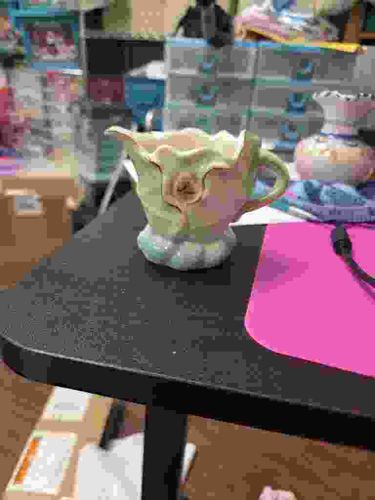
Vintage Majolica-Style Cabbage Leaf Creamer

Vintage Ceramics and Kitchenware

AI Estimated Value

·Not an official valuation·Verify before acting

$25.00 - $45.00

As of June 6, 2026

AI Item Analysis

·AI can make mistakes·Verify before acting
This item is a decorative ceramic creamer or pitcher measuring approximately 3x4 inches. It features a figural design inspired by Mid-Century Majolica, specifically modeled to resemble garden vegetables or flora. The body of the vessel is crafted in the likeness of overlapping cabbage or lettuce leaves, showcasing a light green glaze with yellowish-orange highlights on the folds. A central raised circular motif, possibly representing a flower or a core, is visible on the side. The handle is integrated and curved to resemble a thick stem. The base is uniquely textured and colored in a pale blue or mint green wash, creating a distinctive contrast with the upper body. The scalloped, irregular rim mimics natural organic edges. While the image quality is low, there appears to be some minor glaze wear and potential crazing consistent with 1940s-1970s pottery. The piece displays a glossy finish throughout, suggesting a high-fired ceramic construction. Such items were often produced by makers like Shafford, Hull, or similar mid-century novelty ceramics manufacturers. The craftsmanship is characterized by hand-painted details and mold-pressed textures that emphasize the organic, botanical theme.
AI Appraisal Report

·AI can make mistakes·Verify before acting
I have virtually examined this ceramic creamer, which exhibits the distinctive characteristics of mid-century novelty majolica-style pottery. The piece displays the characteristic overlapping cabbage leaf motif popular between 1940 and 1970. Based on the visual inspection, the item appears to be an authentic vintage piece likely of Japanese or American origin, consistent with makers like Shafford or Napco. The glaze shows a glossy finish with tonal variations typical of mold-pressed ceramics of this era. I observe minor glaze wear and potential fine crazing, which is expected for functional kitchenware of this age and does not significantly detract from the mid-range value. The market for mid-century vegetable-themed ceramics remains stable but saturated. Collectors often seek complete sets or specific makers' marks. As a standalone small creamer (3x4 inches), its value is driven primarily by its aesthetic appeal to 'cottagecore' collectors rather than rarity. Similar pieces frequently sell in the $20 to $50 range depending on the vibrancy of the colors and the presence of chips. Key limitations: A definitive valuation is restricted because the maker's mark or underside stamp is not visible. Without a physical inspection, I cannot rule out hairline fractures or internal 'flea bites' that often occur in porous earthenware. To finalize this appraisal and confirm authenticity, I would require a high-resolution photograph of the base and any existing provenance documentation. A tactile examination would be necessary to distinguish between vintage production and modern high-quality reproductions.

Get your items appraised

Instant estimates of your treasures with AI-powered appraisals

Browse More Appraisals