AI estimate as of August 27, 2025 · verify with a professional before acting
AI-Generated · Verify before acting
Everything on this page is generated by AI for informational purposes only. AI can make mistakes — the AI may misidentify items or misattribute them (artist, maker, brand, designer, origin, era). This is not an official valuation and should not be used for insurance, sale, tax, estate, legal, or lending purposes — or any decision requiring a certified appraisal. It is not an authoritative claim about any person, brand, or rights holder — do not share or rely on it as a factual statement about a third party. Always consult qualified professionals before making financial decisions.
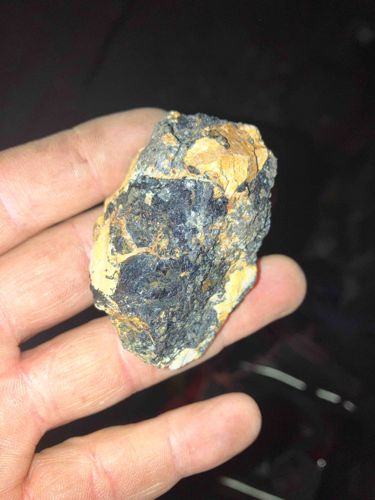
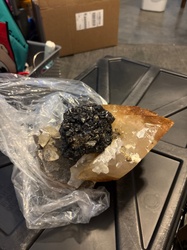
The item is a raw, unrefined mineral specimen, likely an ore or a naturally occurring rock formation. Its approximate size appears to be suitable for holding comfortably in one hand, suggesting dimensions of roughly 2-4 inches in its longest dimension. The primary colors visible are a deep, dark grey to black, mottled with significant areas of an earthy, dull yellow-ochre, and some minor patches of white or very light grey. The texture is rough and irregular, consistent with a naturally fractured or unworked mineral. There are no smooth or polished surfaces, indicating it has not undergone any lapidary processes. The dark material exhibits a somewhat metallic or sub-metallic luster in certain areas, suggesting the presence of metallic minerals, possibly sulfides or oxides. The yellow material appears to be a host rock or weathering product, possibly an iron oxide stain, imparting an oxidized appearance. No specific crystal structures are clearly discernible, but the deep black portions show some evidence of a granular or microcrystalline texture. There are no clear identifying marks, signatures, or manufacturing details as this is a natural specimen. Given its appearance, it is likely geologically ancient, formed over millions of years. Its condition is remarkably intact for a natural specimen, with no visible signs of recent breakage or repair. The yellowing could be a natural patina from weathering or an inherent part of its geological composition. The overall quality points to a specimen of interest for geological study or collection.
AI Appraisal Report
Based on my visual examination of the provided image, this raw mineral specimen, characterized by its dark grey/black and yellow-ochre coloration, appears to be a natural geological formation. Its unrefined state, rough texture, and lack of human modification strongly support its authenticity as a raw mineral. The integrity of the specimen seems good, with no overt signs of recent damage, repair, or artificial alteration. The yellowing is consistent with natural weathering or the presence of iron oxides (ochre).
In terms of market conditions, raw mineral specimens of this type, without specific crystal formations or known rare mineral content, generally appeal to hobbyist collectors, students, or as decorative geological samples. Comparables in the market include common ore samples, geological teaching aids, or decorative "rock garden" specimens. The demand for such a generic unrefined specimen is moderate, primarily driven by educational institutions or entry-level collectors. Rarity is difficult to assess without mineralogical identification; however, its visual characteristics do not suggest extreme rarity.
The primary factors impacting its value are its natural integrity and representative appearance of an ore or weathered rock. However, its lack of identifiable, highly prized mineral content (e.g., gold, silver, specific gemstones, or well-formed rare crystals) significantly limits its monetary value.
It is crucial to note the limitations of authenticity verification from images alone. While visually it appears genuine, full authentication would require physical inspection to confirm tactile properties, density, and detailed textural analysis. Furthermore, definitive identification of the mineral composition, especially of the dark material (e.g., specific metallic sulfides, oxides, or other ore minerals) and the yellow ochre, would necessitate scientific testing such as X-ray diffraction (XRD), X-ray fluorescence (XRF), or microscopic examination. Provenance documentation, detailing where and when the specimen was found, could also enhance its historical or geological significance, thereby potentially impacting value, though this is less critical for common specimens.