AI estimate as of July 16, 2025 · verify with a professional before acting
AI-Generated · Verify before acting
Everything on this page is generated by AI for informational purposes only. AI can make mistakes — the AI may misidentify items or misattribute them (artist, maker, brand, designer, origin, era). This is not an official valuation and should not be used for insurance, sale, tax, estate, legal, or lending purposes — or any decision requiring a certified appraisal. It is not an authoritative claim about any person, brand, or rights holder — do not share or rely on it as a factual statement about a third party. Always consult qualified professionals before making financial decisions.
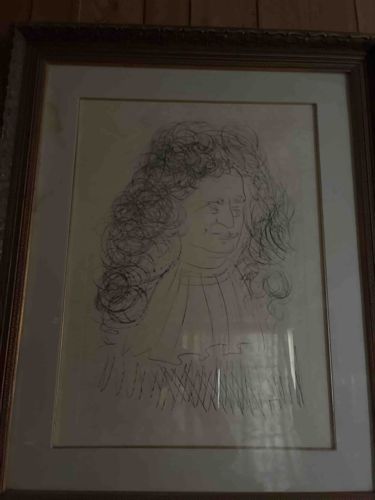
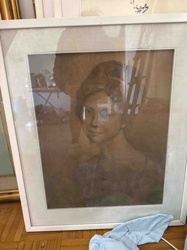
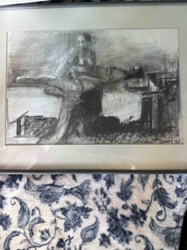
The item is a framed drawing, likely executed in a monochromatic medium such as charcoal, graphite, or ink on paper. The drawing depicts a bust-length portrait of a male figure characterized by an elaborate, curly wig, a prominent mustache, and a hint of a goatee or soul patch. He is also depicted wearing what appears to be a ruffled cravat or jabot, characteristic of 17th or 18th-century European fashion. The lines appear to be fluid and expressive, particularly in the rendering of the wig which utilizes circular and looping strokes. The background of the drawing is largely unadorned, allowing the figure to be the sole focus.
The artwork is housed within a classic wooden frame with an ornate, possibly gilded, inner edge, suggesting a traditional presentation style. There is a white or off-white mat board separating the artwork from the frame, providing visual breathing room. The entire piece is covered by a protective sheet, likely glass or acrylic, which shows some glare in the provided image, obscuring minor details but indicating the artwork is protected. The paper itself appears to be light-toned, possibly cream or off-white, and shows no obvious signs of significant discoloration or foxing, although the lighting makes it difficult to assess perfectly. No clear artist's signature or specific markings are discernible from the image, preventing identification of the creator or specific manufacturing details. The style of the portraiture and attire suggests an estimated age from the Baroque or Rococo periods, or a later work inspired by these eras. The craftsmanship appears to be proficient, displaying a confident hand in the drawing technique. There are no visible signs of damage, wear, or repairs to the artwork itself, but the protective covering causes reflections that make a perfect assessment impossible.
AI Appraisal Report
I have examined the provided image of the framed drawing depicting a man in 17th/18th-century style attire. Based on this visual examination, the artwork appears to be well-preserved. The drawing itself shows no obvious signs of significant damage such as tears, major discoloration, or foxing, though the protective covering's glare makes perfect assessment difficult. The frame and mat board also seem to be in good condition, presenting the piece professionally. This appears to be a proficiently executed drawing, suggesting a skilled hand.
Authenticity, particularly regarding the specific artist and period, cannot be definitively confirmed from an image alone. While the style strongly suggests a Baroque or Rococo influence, or a later homage, without physical inspection, it's impossible to confirm original dating vs. a skilled later reproduction or inspiration. There are no discernible signatures or markings.
In terms of market conditions, drawings of this nature, especially without identified provenance or a known artist, fall into a broad category. Demand exists for decorative historical-style portraits, but rarity is challenging to determine without a verified artist. Comparables typically involve generalized period drawings or quality academic studies. Factors significantly impacting value include the lack of a known artist, the absence of provenance, and the inability to conduct a full in-person condition assessment.
For a full authentication, in-person examination is crucial. This would allow for a detailed inspection of the paper, media, and any subtle markings. Microscopic analysis could help determine the age of the materials. Provenance documentation, such as prior ownership history, would be vital in establishing authenticity and origin. Without these steps, the valuation remains primarily decorative.