AI estimate as of July 6, 2025 · verify with a professional before acting
AI-Generated · Verify before acting
Everything on this page is generated by AI for informational purposes only. AI can make mistakes — the AI may misidentify items or misattribute them (artist, maker, brand, designer, origin, era). This is not an official valuation and should not be used for insurance, sale, tax, estate, legal, or lending purposes — or any decision requiring a certified appraisal. It is not an authoritative claim about any person, brand, or rights holder — do not share or rely on it as a factual statement about a third party. Always consult qualified professionals before making financial decisions.
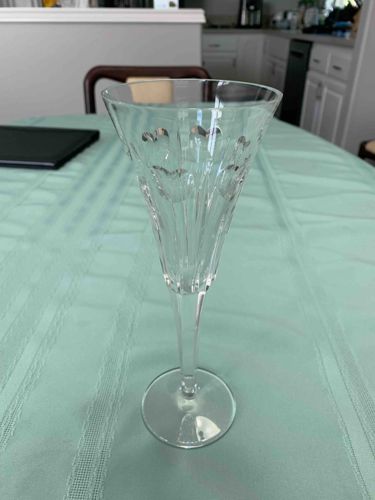
This item is a clear crystal champagne flute, distinguished by its elegant and tapered bowl. The material appears to be high-quality lead crystal or a similar clear glass, exhibiting excellent clarity and light refraction, particularly visible through the faceted cuts. The bowl of the flute features a distinct pattern of vertical cuts or fluting that radiate upwards from the stem, creating a sense of height and sophistication. Interspersed within these vertical lines are decorative etched or cut elements that resemble small, stylized hearts or an abstract leaf shape, arranged in a repeating band around the upper portion of the bowl. The stem is slender and unfaceted, gradually widening towards the base. The foot, or base, is circular and flat, providing stable support for the tall glass. No obvious chips, cracks, or significant wear are visible from the image, suggesting it is in very good to excellent condition. The surface glistens, indicating a well-maintained piece with minimal scratching or cloudiness. There are no discernible maker's marks or signatures visible in the provided image. Based on its design and craftsmanship, it likely dates from the mid-20th century to the present day, possibly a mass-produced, yet high-quality, item commonly found in tableware sets or sold individually for special occasions. The precise cutting and polished surfaces are indicative of good-quality manufacturing.
AI Appraisal Report
Upon my virtual examination of this crystal champagne flute, I observe a piece in very good to excellent condition. The clarity and refraction of light suggest high-quality lead crystal or a similar clear glass. The vertical fluting and the repeating heart/leaf etching are well-executed, indicative of good manufacturing. There are no visible chips, cracks, or significant wear, and the surface appears well-maintained with minimal scratching.
Authenticity is difficult to definitively determine from images alone. While its design and craftsmanship align with mid-20th century to contemporary mass-produced, high-quality glassware, the absence of maker's marks is a limitation. Many producers created similar designs. For full authentication and to ascertain the exact manufacturer and specific crystal composition, an in-person examination would be crucial. This would allow for tactile inspection, detailed analysis of the cuts and etching, and UV light testing for lead content or repairs. Provenance documentation, such as original sales receipts or gift records, would also significantly aid in authentication and potentially enhance value.
Market conditions for single champagne flutes, even high-quality ones, are generally modest unless they are part of a rare or highly collectible set, or by a renowned luxury brand. Comparables include individual flutes from brands like Waterford, Baccarat, or Orrefors, which, depending on the pattern and age, can range from \"20-\$100\" or more. However, unbranded items typically fetch lower prices. Demand for single, unbranded flutes is low; most buyers seek sets. Rarity is also low given the likely mass-produced nature. Without a brand name or unique historical significance, value is primarily driven by aesthetic appeal and perceived quality. The lack of identifying marks significantly impacts its potential for higher value, placing it more in the realm of attractive decorative glassware rather than a collectible antique.
Based on these factors, particularly the lack of visible maker's marks and the item being a single flute, its appraisal value is modest.