AI Appraisal Estimate

AI-generated estimates · not official valuations

From the user

What was submitted

Photo and notes provided by the user — not generated by AI

Submitted item photo
Submitted photo · June 13, 2026

User's notes

Picture

AI analysis below

AI appraisal

AI analysis & estimate

AI-Generated · Verify before acting

Everything below is generated by AI for informational purposes only. AI can make mistakes — the AI may misidentify items or misattribute them (artist, maker, brand, designer, origin, era). This is not an official valuation and should not be used for insurance, sale, tax, estate, legal, or lending purposes — or any decision requiring a certified appraisal. It is not an authoritative claim about any person, brand, or rights holder — do not share or rely on it as a factual statement about a third party. Always consult qualified professionals before making financial decisions.

Note

This analysis also relies on unverified notes provided by the user, which may be incomplete or inaccurate and could affect the result.

Read the full disclaimer

AI Identification

·Not independently authenticated·Verify before acting

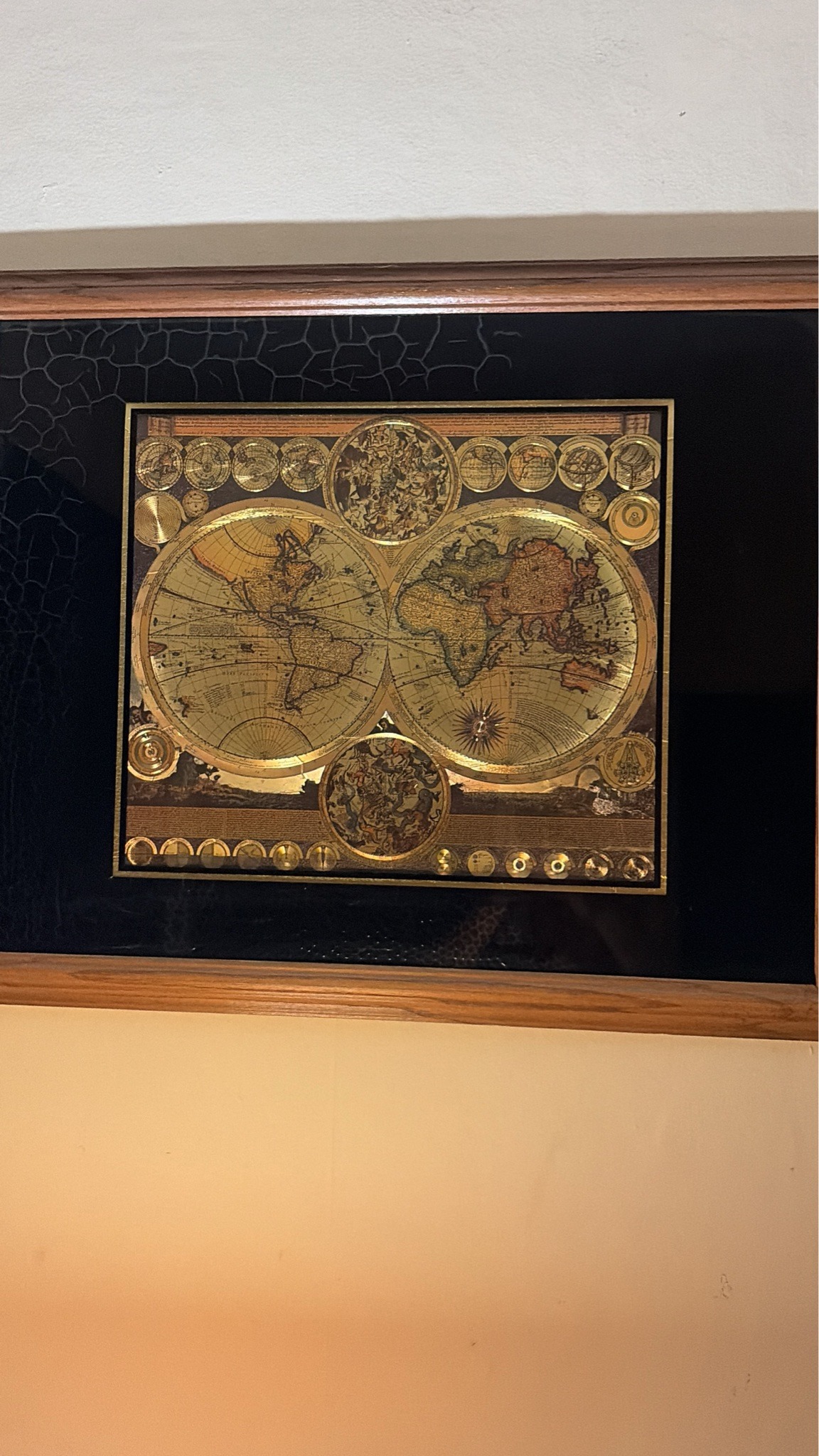
Framed gold-toned metallic foil map in the style of 17th-century cartography

Wall Art

AI Estimated Value

·Not an official valuation·Verify before acting

$45–$120

As of June 13, 2026

AI Item Analysis

·AI can make mistakes·Verify before acting
This item appears to be a decorative wall hanging consisting of a rectangular metallic foil map housed within a wooden frame and set against a dark, textured background. The central artwork is a world map in a double-hemisphere projection, stylistically consistent with late 17th-century European cartography, specifically resembling designs by Dutch cartographers such as Frederick de Wit or Nicolaes Visscher. The map features golden and brassy hues with etched or embossed details that create a reflective, metallic surface. Surrounding the two main spheres are various astronomical diagrams, celestial hemispheres, and smaller circular vignettes typical of Baroque-era map designs. The artwork is mounted on a black panel with a noticeable 'crackle' or webbed texture. It is enclosed in a simple wood-grain frame. No specific maker's marks or signatures are legible in the provided image, and without physical inspection, it is impossible to determine if this is a vintage lithograph on foil or a contemporary reproduction. The condition appears stable, though there is a visible vertical seam or line running through the left hemisphere, which may be a manufacturing join or a surface crack in the foil material. This identification is based solely on stylistic features as the image lacks verifiable provenance or manufacturer labels.

AI Appraisal Report

·AI can make mistakes·Verify before acting
Based on my visual analysis of the provided image, I have evaluated this framed metallic foil world map. The artwork exhibits stylistic characteristics of late 17th-century Dutch cartography, specifically mimicking the double-hemisphere projections favored by makers like Nicolaes Visscher. However, based on what I can see, the metallic foil and crackle-textured mounting strongly suggest this is a mid-to-late 20th-century decorative reproduction rather than an antique document. I cannot verify the exact age or manufacturer from a photo, as there are no visible maker's marks or signatures. The vertical seam in the left hemisphere may be a manufacturing artifact common in mass-produced foil wall art. The value estimate of $45–$120 assumes this is a vintage decorative piece in stable condition. This market is driven by interior design trends for 'Old World' aesthetics; demand is steady for well-preserved examples. If this item were an actual 17th-century hand-colored engraving, its value would reach several thousand dollars. Conversely, if it is a contemporary, low-quality reproduction on plasticized foil, the value would likely fall below $30. To confirm its status, a physical inspection is required to determine the substrate (paper vs. synthetic), the printing method, and the age of the wooden frame. Provenance documentation would also be necessary to elevate the piece beyond a purely decorative classification. Without such verification, it must be treated as a decorative object in the style of historical cartography rather than a rare collectible.

Related Tags

Explore similar items and categories

Get your items appraised

Instant estimates of your treasures with AI-powered appraisals

Browse More Appraisals