AI estimate as of August 11, 2025 · verify with a professional before acting
AI-Generated · Verify before acting
Everything on this page is generated by AI for informational purposes only. AI can make mistakes — the AI may misidentify items or misattribute them (artist, maker, brand, designer, origin, era). This is not an official valuation and should not be used for insurance, sale, tax, estate, legal, or lending purposes — or any decision requiring a certified appraisal. It is not an authoritative claim about any person, brand, or rights holder — do not share or rely on it as a factual statement about a third party. Always consult qualified professionals before making financial decisions.
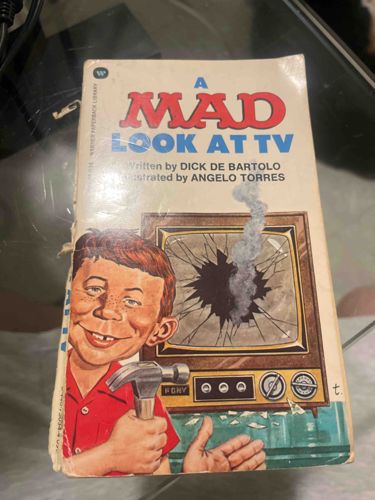
This item is a vintage paperback book titled "A MAD LOOK AT TV", written by Dick De Bartolo and illustrated by Angelo Torres. The cover art features the iconic Mad Magazine mascot, Alfred E. Neuman, with his characteristic gap-toothed grin and red hair. He is depicted holding a hammer, having seemingly just smashed the screen of a retro-style television set, from which smoke is emanating. The TV itself is brown with a green bottom section, featuring various knobs and what appears to be a speaker grille.
The book's cover suggests a comedic or satirical take on television, consistent with Mad Magazine's style. The physical condition indicates significant wear from age and handling. There are visible creases, scuffs, and abrasions on the cover, particularly along the edges and spine, suggesting that the book has been read multiple times. The corners are softened and show signs of bending and minor losses. The spine, though not fully visible, appears to be creased and possibly slightly torn at the top or bottom edges, as is typical for older paperbacks. The colors on the cover are still relatively vibrant but may be slightly faded, as expected for a vintage item. The 'W' logo for Warner Paperback Library is visible in the upper left corner, indicating the publisher. The overall appearance points to a mid-to-late 20th-century publication, likely from the 1960s or 1970s, based on the art style and television design.
AI Appraisal Report
I have examined the provided image of "A MAD LOOK AT TV" paperback, written by Dick De Bartolo and illustrated by Angelo Torres. Based on the visual cues, this appears to be a genuine vintage Warner Paperback Library publication, likely from the late 1960s or early 1970s given the television style and publisher's branding. The iconic Alfred E. Neuman cover art is consistent with Mad Magazine's satirical themes.
From the image, the condition is fair to good, exhibiting significant wear commensurate with its age and use. I note visible creasing, scuffs, and abrasions across the cover and along the edges. The corners are softened, and minor losses are present. While the spine isn't fully visible, the general condition suggests typical wear for an older paperback, likely including creasing. Despite the wear, the colors appear relatively vibrant for a vintage item.
In terms of market conditions, vintage Mad Magazine paperbacks generally have a modest but consistent demand among collectors of humor, pop culture, and Mad Magazine memorabilia. Comparables for similar condition Mad paperbacks often range from a few dollars to up to $20-30, depending on the specific title, condition, and scarcity. This particular title is not exceptionally rare, but the iconic cover art featuring Alfred E. Neuman is a positive factor.
Factors impacting value significantly are its condition and the fact that it's a mass-produced paperback. Higher-grade copies would command slightly more. Without physical inspection, I cannot confirm the integrity of the binding, presence of internal tears, or any odor issues (e.g., smoke, mildew) that could diminish value significantly. Full authentication beyond visual cues would require in-person examination to verify paper quality, printing details, and to check for restoration or alterations. Provenance documentation could also add to its historical value, though it's less common for these types of items.
For an item of this nature, given its condition and market, an in-person assessment would primarily confirm the overall feel, subtle imperfections, and ensure no major undisclosed flaws affecting structural integrity or appearance that aren't apparent in the image.