AI estimate as of July 17, 2025 · verify with a professional before acting
AI-Generated · Verify before acting
Everything on this page is generated by AI for informational purposes only. AI can make mistakes — the AI may misidentify items or misattribute them (artist, maker, brand, designer, origin, era). This is not an official valuation and should not be used for insurance, sale, tax, estate, legal, or lending purposes — or any decision requiring a certified appraisal. It is not an authoritative claim about any person, brand, or rights holder — do not share or rely on it as a factual statement about a third party. Always consult qualified professionals before making financial decisions.
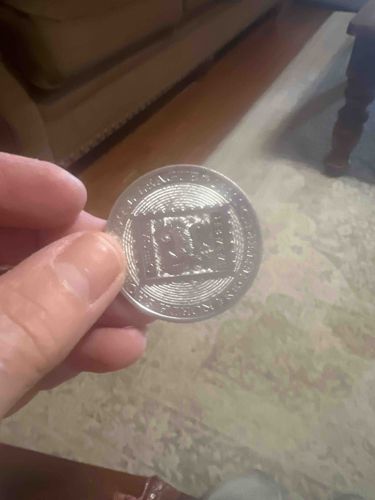
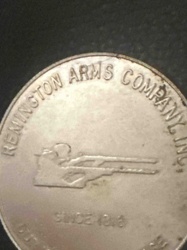
The item is a round, metallic coin or medallion, likely made of silver or a silver-toned metal, given its reflective, light-grey appearance. The diameter appears to be roughly 1.5 to 2 inches, held between a thumb and forefinger. The primary observable side features a central design resembling a postage stamp or a framed image, within which indistinct imagery or text is present. Surrounding this central motif are concentric rings or a pattern of fine, incised lines that extend towards the rim. Along the outer edge, there is a circular inscription, though the text is largely illegible from the provided image quality. The overall surface appears to be in good condition with a polished finish, showing minimal signs of wear or significant scratching. There are no obvious dents, deep abrasions, or discernible patina. The craftsmanship suggests a machine-struck item, with precise and uniform details, indicating a modern manufacturing process rather than hand-forged. The item does not display any distinct maker's marks or dates that are visible, making an exact age or origin difficult to pinpoint without further information. The raised details and clear-cut edges suggest a good quality strike, indicative of a well-preserved or recently minted piece.
AI Appraisal Report
Upon examining the provided image of this silver-toned commemorative coin/medallion, I note its good visual condition. The highly reflective surface indicates either a polished silver composition or a silver-toned base metal. The apparent diameter of 1.5 to 2 inches is a standard size for commemorative pieces. The central stamp-like design is intriguing, though its indistinct imagery prevents identification of its specific commemorative purpose. The concentric rings and circular inscription along the rim suggest a well-designed, machine-struck item. There are no obvious signs of significant wear, deep abrasions, or patina, suggesting it is either well-preserved or relatively modern. The lack of visible maker's marks, dates, or clear textual inscriptions is a significant limitation.
Market conditions for generic commemorative medallions tend to be moderate unless tied to significant historical events, famous figures, or precious metal content. Without knowing the metal purity (e.g., sterling silver, silver-plated, or base metal), its intrinsic value cannot be determined. If it's a base metal, its value is purely numismatic or sentimental. Demand and rarity are currently undeterminable; many such items are mass-produced souvenirs. If it commemorates a rare event, or is made of a significant precious metal, its value could increase.
My assessment of authenticity is limited to visual inspection. The strike quality appears good, but genuine material and precise details cannot be verified from an image. For a full authentication, I would need a physical examination to: 1) test the metal composition (e.g., specific gravity, XRF analysis) to confirm silver content and purity, 2) examine the edges for seams or wear patterns not visible, 3) use magnification to identify faint details, mint marks, or inscriptions, and 4) review any provenance documentation (e.g., certificates of authenticity, purchase records) that might accompany the item.