AI estimate as of August 28, 2025 · verify with a professional before acting
AI-Generated · Verify before acting
Everything on this page is generated by AI for informational purposes only. AI can make mistakes — the AI may misidentify items or misattribute them (artist, maker, brand, designer, origin, era). This is not an official valuation and should not be used for insurance, sale, tax, estate, legal, or lending purposes — or any decision requiring a certified appraisal. It is not an authoritative claim about any person, brand, or rights holder — do not share or rely on it as a factual statement about a third party. Always consult qualified professionals before making financial decisions.
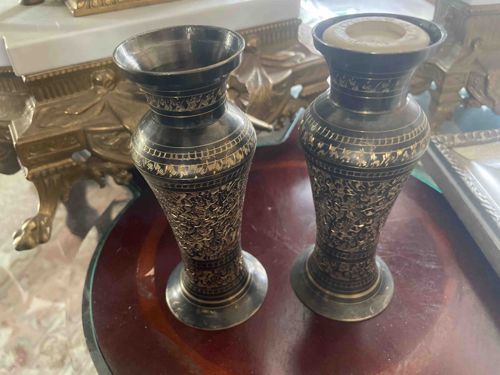
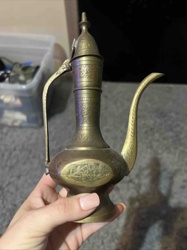
This lot features a pair of metal vases, likely made from brass or a similar alloy, with a distinctive dark, possibly oxidized or blackened, finish. The intricate decoration appears to be achieved through metal inlay work, specifically Bidriware, where patterns are inlaid with silver or brass onto a dark copper-zinc alloy. The predominant colors are the dark base metal and the shimmering silver-toned inlay, which is visible in detailed floral and geometric motifs covering the majority of the body. Each vase has a flared mouth, a slender neck, a wider body that tapers towards the base, and a round, stable foot. The height of the vases appears to be between 8 to 12 inches based on the visual context. The craftsmanship is indicative of traditional Indian decorative arts, likely from the late 19th or early 20th century, given the style of inlay and form. There are no visible chips or cracks, but the dark finish shows some areas of wear and minor tarnishing, consistent with age and handling. One vase has a light-colored, possibly ceramic or plaster, insert within its opening, which suggests it might have been used as a candlestick holder or for a specific floral arrangement. The other vase is open. The overall condition is good, showing appropriate patina and minor surface abrasions, but no significant damage that would detract from their decorative appeal. The intricate detailing points to skilled artisan work.
AI Appraisal Report
Based on my visual examination of the provided image, this pair of metal vases displays characteristics consistent with Bidriware, a traditional Indian metal inlay art. The dark base metal, likely a copper-zinc alloy, intricately inlaid with shimmering silver motifs, strongly suggests this technique. The floral and geometric patterns, along with the form (flared mouth, slender neck, wider body, and stable foot), align with typical Bidriware craftsmanship. I estimate their height to be 8-12 inches, which is a common size for decorative vases of this type.
The condition appears good, showing appropriate patina and minor surface abrasions consistent with age and handling. I observe no major chips or cracks, although some wear and minor tarnishing are evident, which is expected for items likely from the late 19th or early 20th century. The presence of a light-colored insert in one vase is an interesting detail, suggesting potential past use. This does not negatively impact value.
In terms of market conditions, Bidriware items, especially well-crafted pairs, generally have a steady demand among collectors of Indian decorative arts and global enthusiasts of metalwork. Comparables for items of this quality and period range widely. Factors impacting value include the intricacy of the inlay, the condition, and the age. The fact that it is a matching pair enhances its desirability and value. Rarity is moderate; while Bidriware is not exceedingly rare, high-quality, intact pairs are less common.
My assessment of authenticity is based purely on visual cues from the image. Without physical inspection, I cannot definitively confirm the metal composition, the exact age, or the authenticity of the inlay technique. Further authentication would require in-person examination to verify the material composition, close scrutiny of the inlay technique for tool marks and craftsmanship consistency, and ideally, provenance documentation. Scientific testing, such as XRF analysis, could confirm metal composition. However, based on the image, the visual evidence strongly supports the Bidriware attribution.