These notes were written by the person who submitted this item. Appraiser.AI has not verified them, and the AI's identification and estimate may rely on them.
AI Estimated Value
Not an official valuation
$0.50 - $1.00
AI estimate as of August 28, 2025 · verify with a professional before acting
AI-Generated · Verify before acting
Everything on this page is generated by AI for informational purposes only. AI can make mistakes — the AI may misidentify items or misattribute them (artist, maker, brand, designer, origin, era). This is not an official valuation and should not be used for insurance, sale, tax, estate, legal, or lending purposes — or any decision requiring a certified appraisal. It is not an authoritative claim about any person, brand, or rights holder — do not share or rely on it as a factual statement about a third party. Always consult qualified professionals before making financial decisions.
This analysis also relies on unverified notes provided by the user, which may be incomplete or inaccurate and could affect the result.
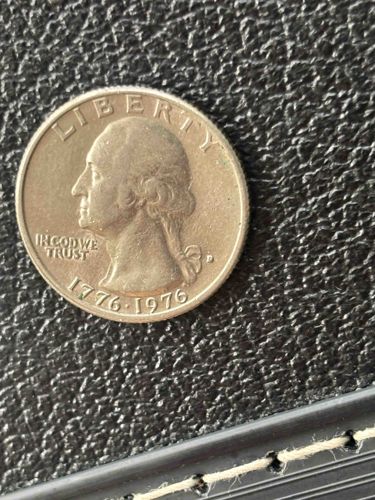
This item is identified as a Bicentennial Quarter, specifically the obverse side (heads) of a United States Washington quarter dollar coin. Its physical characteristics include a circular shape, a metallic silver-grey color typical of clad coinage, and a reeded edge (though not visible in this image, it's standard for US quarters). The coin depicts the left-facing profile of George Washington. Above his head, the word "LIBERTY" is inscribed, arcing along the top rim. To his left, below his chin, are the words "IN GOD WE TRUST". Uniquely for a Bicentennial quarter, instead of a single minting year, the dates "1776 - 1976" are prominently displayed below Washington's bust, marking the American Bicentennial. A faint mint mark, which appears to be a 'D' (Denver Mint), is visible to the right of Washington's braid. The surface exhibits some signs of circulation wear, typical for a coin of this age, including minor scratches and dulling of the original luster. There is no significant damage or striking errors immediately apparent. The craftsmanship is consistent with mass-produced coinage from the United States Mint. The estimated age is 1976, given the bicentennial dating. The specific details of the portrait and inscriptions are well-defined, suggesting a standard strike, neither proof nor exceptionally worn, indicating it was likely used in general circulation.
AI Appraisal Report
I have examined the provided image of the United States Bicentennial Quarter (Obverse), alongside the owner's detailed description. Based on this, I assess the coin as authentic, consistent with a standard issue 1976-D Bicentennial Quarter. The '1776-1976' dual date and the specific depiction of Washington are correct for this series. The visible 'D' mint mark confirms it was struck at the Denver Mint.
The condition, as observed, appears to be Extra Fine (XF) to About Uncirculated (AU). There are minor signs of circulation wear, typical for a coin that has entered commerce, including slight dullness and minor scratches, but the details of Washington's hair, inscriptions, and the rim remain quite sharp. This is well within the typical condition range for such coins encountered by collectors.
Regarding market conditions, Bicentennial Quarters were mass-produced, with billions minted across Philadelphia, Denver, and San Francisco. Consequently, they are not rare. There is consistent collector demand, but primarily for higher-grade examples (uncirculated or proof). Coins in the XF/AU range like this one are commonly available.
Factors significantly impacting value include the commonness of the issue, the 'D' mint mark (the most common for this type), and the observed circulation. While not heavily circulated, it lacks the pristine luster of an uncirculated specimen. For a common coin like this, minor wear significantly affects its numismatic premium.
My primary limitation in authentication and precise grading is the reliance on images alone. A physical in-person examination would allow for a more accurate assessment of surface luster, subtle wear patterns, edge condition, and potential hidden flaws not visible in a static image. Moreover, a physical inspection helps confirm the metallic composition and weight, which, while unlikely to be an issue for a common quarter, is a standard part of full authentication. No specific provenance documentation or scientific testing is typically required for a coin of this common nature unless significant anomalies were suspected.