AI estimate as of September 14, 2025 · verify with a professional before acting
AI-Generated · Verify before acting
Everything on this page is generated by AI for informational purposes only. AI can make mistakes — the AI may misidentify items or misattribute them (artist, maker, brand, designer, origin, era). This is not an official valuation and should not be used for insurance, sale, tax, estate, legal, or lending purposes — or any decision requiring a certified appraisal. It is not an authoritative claim about any person, brand, or rights holder — do not share or rely on it as a factual statement about a third party. Always consult qualified professionals before making financial decisions.
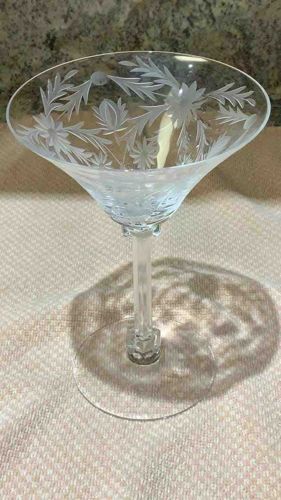
This item is a clear crystal or high-quality glass martini or coupe-style cocktail glass, featuring a distinctive etched floral and foliate pattern around the bowl. The glass exhibits a classic inverted cone-shaped bowl, typical for martini glasses, tapering down to a short, faceted knop at the base of the bowl, just above a relatively tall, slender stem. The stem is unadorned and terminates in a round, flat foot, also made of clear glass. The etching on the bowl is quite intricate, depicting various types of flowers, possibly thistles or intricate blossoms, interspersed with detailed leaves and swirling tendrils, creating a dense and elegant band of decoration that covers the upper half of the bowl. The etching appears to be hand-done or finely machine-etched, showing good detail and consistency. The item's material is transparent, suggesting either crystal or high-quality glass, which reflects light beautifully, indicating good clarity and likely a fine composition. There are no visible chips, cracks, or significant wear evident from the image, suggesting it is in good to excellent condition. The overall design suggests a style period from the early to mid-20th century, possibly Art Deco or mid-century modern, where etched glassware was a popular decorative element. The craftsmanship appears to be of a high standard, given the intricate etching and balanced proportions. The base shows a slight thickness and a smooth finish, contributing to the stability of the glass.
AI Appraisal Report
Based on my visual examination of the provided image, this Etched Crystal Martini Glass with Floral and Foliate Design appears to be in excellent condition. I observe no visible chips, cracks, or significant wear. The clarity of the material and the intricate detail of the etching suggest high-quality craftsmanship, likely crystal or a very fine leaded glass. The design, with its classic inverted cone bowl, faceted knop, and detailed floral and foliate etching, strongly points to a style period of the early to mid-20th century, possibly Art Deco or immediately post-Art Deco. The etching appears consistent and well-executed, indicating either skilled hand-etching or precision machine work from a reputable manufacturer.
In terms of market conditions, etched glassware from this era, particularly individual pieces of this quality, generally commands moderate value. Comparables would include etched martini or coupe glasses by makers such as Fostoria, Cambridge, or Morgantown, which often sell in the $30-$80 range per glass, depending on the pattern's rarity and the manufacturer. Demand for vintage barware remains steady, especially for distinctive and well-preserved examples. This particular pattern, while elegant, does not immediately strike me as exceedingly rare, which would significantly drive up individual value.
A significant factor impacting value is the item's condition, which, as I noted, appears excellent from the image. Its aesthetic appeal is high, contributing positively to its desirability. However, without a physical inspection, I cannot definitively confirm the material (crystal versus high-quality glass), weight, or manufacturer. An in-person examination would allow me to check for manufacturer's marks, assess the true depth and feel of the etching, and verify the absence of micro-flaws. Provenance documentation, such as original sales receipts or manufacturer information, would greatly assist in full authentication and could potentially increase value if linked to a particularly desirable maker.