These notes were written by the person who submitted this item. Appraiser.AI has not verified them, and the AI's identification and estimate may rely on them.
AI Estimated Value
Not an official valuation
$150-250
AI estimate as of August 1, 2025 · verify with a professional before acting
AI-Generated · Verify before acting
Everything on this page is generated by AI for informational purposes only. AI can make mistakes — the AI may misidentify items or misattribute them (artist, maker, brand, designer, origin, era). This is not an official valuation and should not be used for insurance, sale, tax, estate, legal, or lending purposes — or any decision requiring a certified appraisal. It is not an authoritative claim about any person, brand, or rights holder — do not share or rely on it as a factual statement about a third party. Always consult qualified professionals before making financial decisions.
This analysis also relies on unverified notes provided by the user, which may be incomplete or inaccurate and could affect the result.
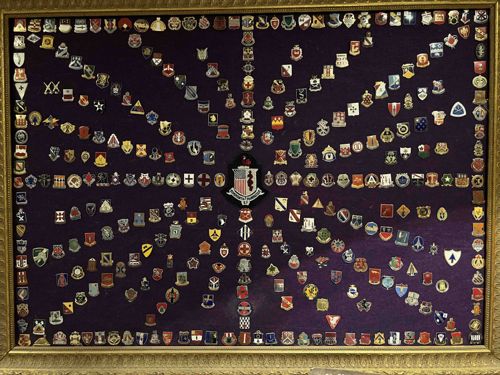
This item is a framed display of numerous distinct unit insignia pins, likely from various military branches, prominently identified by their distinctive heraldic designs. The collection is housed within a gilded wooden frame, suggesting a formal presentation. The pins are meticulously arranged on a purple fabric backing, fanning out in rays from a central, larger insignia patch. The individual pins vary in shape, often shield-shaped or geometric, and are constructed from metal, typically enameled or featuring various finishes such as gold or silver tones. Colors observed on the pins include red, white, blue, green, yellow, black, and various metallic hues. Each pin appears to be a unique design, featuring symbols such as crossed rifles, stars, swords, castles, animals, and abstract shapes, indicating specific units or distinctions. The overall condition appears to be very good, with the pins showing minimal signs of wear or damage. The purple fabric backing seems clean and unfaded. The wooden frame, while not showing significant damage, may exhibit minor scuffs or dust consistent with age and display. No specific maker's marks are discernible from the image, but the consistent quality and uniformity of production suggest they are official military issue or high-quality replicas. The style period is likely mid to late 20th century, given the prevalent designs and enamel techniques, though individual pins could span a broader timeframe. The arrangement itself is a notable feature, indicating a deliberate and artful display of a cherished collection. The craftsmanship of the individual pins is evident in their detailed designs and vibrant enameling.
AI Appraisal Report
I have examined the provided image of the framed military unit insignia pin collection. The overall condition appears very good. The pins themselves show minimal wear, and the purple fabric backing seems clean and well-maintained. The gilded wooden frame, while showing minor signs of use, is suitable for display. The 'Art project' designation by the owner is significant, suggesting this is a curated display rather than a random collection, which enhances its aesthetic appeal.
Assessing authenticity from an image alone is challenging. While the pins appear to be of good quality and consistent with official military issue, without physical inspection, it is impossible to definitively confirm if they are original period pieces, high-quality replicas, or a mix. Maker's marks, material analysis, and detailed examination of the pinbacks would be crucial for full authentication. Provenance documentation, such as service records or acquisition histories, would also significantly aid in verification.
In terms of market conditions, individual military insignia pins vary widely in value based on rarity, historical significance, and unit. However, as an assembled 'art project,' the collective value shifts. While an individual common pin might be a few dollars, a well-curated and aesthetically pleasing display can attract collectors interested in militaria and decorative arts. Comparables would include other framed collections of pins, badges, or militaria, where presentation adds value.
Demand for such curated displays is niche but consistent among military collectors and decorators. The rarity of the specific pins cannot be fully determined from the image, but the overall presentation is unique. Factors impacting value include the authenticity of the pins (original vs. replica), the historical significance of the units represented, and the overall aesthetic appeal of the arrangement. Given the limitations of image-based appraisal, I am valuing this as a decorative militaria collection. Physical inspection, the ability to examine each pin individually, and provenance research would be necessary to increase confidence in authenticity and refine the appraisal.