AI estimate as of July 4, 2025 · verify with a professional before acting
AI-Generated · Verify before acting
Everything on this page is generated by AI for informational purposes only. AI can make mistakes — the AI may misidentify items or misattribute them (artist, maker, brand, designer, origin, era). This is not an official valuation and should not be used for insurance, sale, tax, estate, legal, or lending purposes — or any decision requiring a certified appraisal. It is not an authoritative claim about any person, brand, or rights holder — do not share or rely on it as a factual statement about a third party. Always consult qualified professionals before making financial decisions.
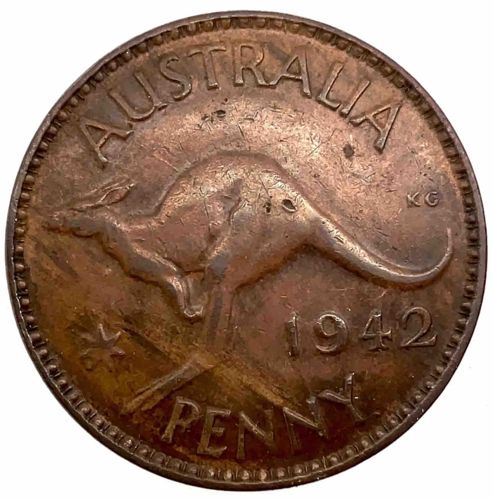
This is a 1942 Australian Penny coin, made of bronze, exhibiting a reddish-brown patina consistent with aged copper alloys. The coin is circular with a reeded edge, though the reeding appears somewhat worn due to circulation. The obverse side, as depicted, features a dynamic design of a kangaroo in mid-leap, facing right. Above the kangaroo, curved along the top edge, are the incused letters spelling 'AUSTRALIA'. Below the kangaroo, the denomination 'PENNY' is visible in a straight line, underneath which is a stylized seven-pointed star, representing the Commonwealth Star. The year '1942' is clearly stamped to the right of the kangaroo's hind legs. To the right of the kangaroo's head, the initials 'KG' are faintly visible, indicating the designer, George Kruger Gray. The surface shows signs of significant wear, including numerous small scratches, nicks, and abrasions across the fields and high points of the design, which are flattened in areas. There are no obvious signs of major damage or repairs, but the natural aging process is evident through the varied toning and some discoloration. Despite the wear, the primary design elements and inscriptions remain legible, indicating its general circulated condition. The craftsmanship is typical for mass-produced coinage of the period, demonstrating clear detail in the initial strike, though much of the finer detail has been lost over time.
AI Appraisal Report
I have carefully examined the provided image of this 1942 Australian Penny coin. Based on the visual evidence, the coin appears to be authentic, exhibiting design elements and wear patterns consistent with known examples of this issue. The presence of the 'KG' initials, the correct typography for 'AUSTRALIA' and 'PENNY', and the overall reddish-brown patina are all indications of its legitimacy. The coin is in a significantly circulated condition, characterized by numerous small scratches, nicks, and abrasions. The high points of the design, particularly on the kangaroo's fur and the Commonwealth Star, are flattened, and the reeding on the edge is worn. While the primary design elements remain legible, much of the finer detail has been lost. This level of wear places the coin in the 'Good' to 'Very Good' circulated grades (G-VG).
Regarding market conditions, 1942 Australian Pennies are common date coins with fairly high mintages. There is consistent demand from collectors, particularly those assembling date sets or colonial coinage collections. However, due to its commonality and the heavily circulated condition, rarity is not a significant factor here. Comparables in similar circulated grades typically trade for modest amounts. Factors significantly impacting value are primarily the extensive wear, which limits its appeal to advanced collectors seeking higher grades. There are no obvious signs of major damage, cleaning, or repairs that would drastically reduce its value further than the circulation wear already does.
It is important to note the limitations of authenticity verification from images alone. While this coin appears genuine based on visual cues, a full authentication would require in-person examination to assess its weight, diameter, thickness, edge characteristics, and metallic composition. Scientific testing, such as X-ray fluorescence (XRF), could confirm the bronze alloy. Provenance documentation, though less critical for common circulated coins, would also provide additional certainty. Without physical inspection, I cannot account for subtle surface alterations, environmental damage not visible in the image, or potential counterfeits that accurately mimic visual aspects but fail physical checks.